A work-at-height permit is the authorisation document required in Russia before any high-risk fall-hazard operation may start. It records the location, conditions, crew composition, safety measures and personal accountability of each responsible officer. This guide covers: when and at what elevation the document must be issued, who is authorised to issue it, how to fill in the form under Order No. 782n, its validity period, storage rules and the penalties for violations. It is intended for HSE engineers, department heads and industrial-safety specialists. A general reference guide on the permit-to-work system is available on the main page.
Contents
1. What a work-at-height permit is and why it matters2. When a permit must be issued3. At what height a permit is required4. Who issues the document: responsible officers5. Safety groups6. Crew composition7. Organising height operations under a permit8. Filling out the form9. Validity and storage10. Height operations without a permit11. Penalties and liability12. FAQ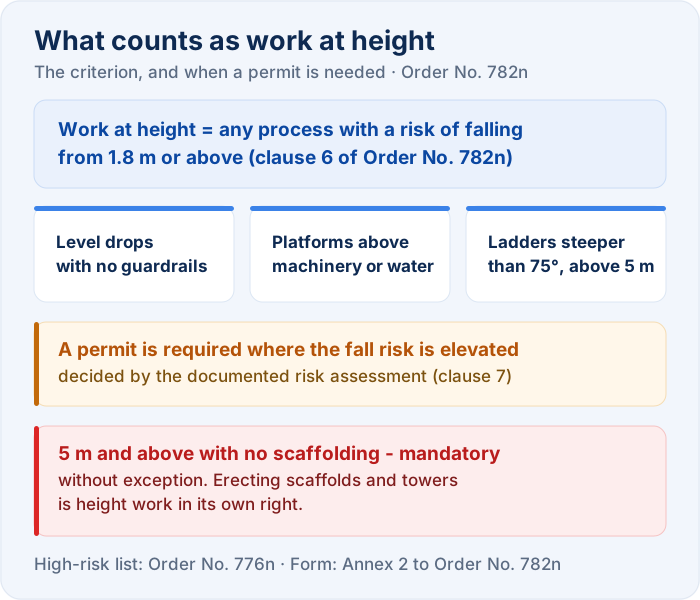
1. What a work-at-height permit is and why it matters
A work-at-height permit is a written task authorisation for safely performing high-risk elevated operations, issued on a special form. The recommended template is given in Annex 2 to the Safety Rules for Work at Height (Order No. 782n of the Russian Ministry of Labour, as amended 29 April 2025, in force until 1 September 2031).
In plain terms, it is a written permission to enter a work zone where a person could fall and be seriously injured. Starting high-risk height operations without this document is prohibited. Full stop.
| Purpose | What is recorded | Why it matters |
|---|---|---|
| Working conditions | Exact location (building, elevation mark, axis), nature of operations, list of hazards | So the crew and inspectors know exactly where and what is being done |
| Safety measures | Fall-protection systems (restraint, positioning, fall-arrest, rescue), PPE, barriers and signs | So everyone knows how they are protected — specifically: which system, which standard |
| Personal accountability | Full names of the issuer, supervisor, executor and every crew member | So that during an investigation it is clear who was responsible for what |
Two copies are issued, and the issuer hands both of them to the responsible supervisor (clause 54(e) of the Rules). The issuance is registered in the logbook (Annex 5). The form may be filled in by hand or on a computer, but without corrections. Any strikethrough or blot requires reissuance. The rule is strict — corrections in the authorisation document are prohibited.
Why this is so important
According to Rostrud, Russia's Federal Service for Labour and Employment, falls between levels account for roughly 23 % of all severe workplace accidents. Height operations consistently rank in the top three most injury-prone activities. A telling example: at a refinery in Bashkortostan, three falls from pipe racks were recorded in a single year. All three cases had one thing in common: the permit had either not been issued or had been filled in pro forma.
A common question: "Why so much paperwork if people already know what they are doing?" The statistics answer directly: at facilities with a fully implemented permit-to-work system and daily oversight, incident rates drop by 40 to 60 % in the first year alone. At one refinery in Ufa, after switching to electronic permits (with automatic deadline tracking), not a single fall from height was recorded over two years. Previously, three to four cases were recorded annually.
Where the work-at-height permit is used most often
| Sector | Typical tasks |
|---|---|
| Construction & assembly | Façade and roofing work, steel-structure erection |
| Oil & gas | Servicing tanks, pipe racks, flare systems |
| Power engineering | Overhead-line and substation repairs |
| Industrial production | Crane and process-equipment servicing |
| Utilities | Roof repairs, engineering-network maintenance |
The document requirements and officer qualifications are the same regardless of the sector. All are governed by Order No. 782n.
See also: «Issuing a permit-to-work: step-by-step guide 2026».
2. When a permit must be issued
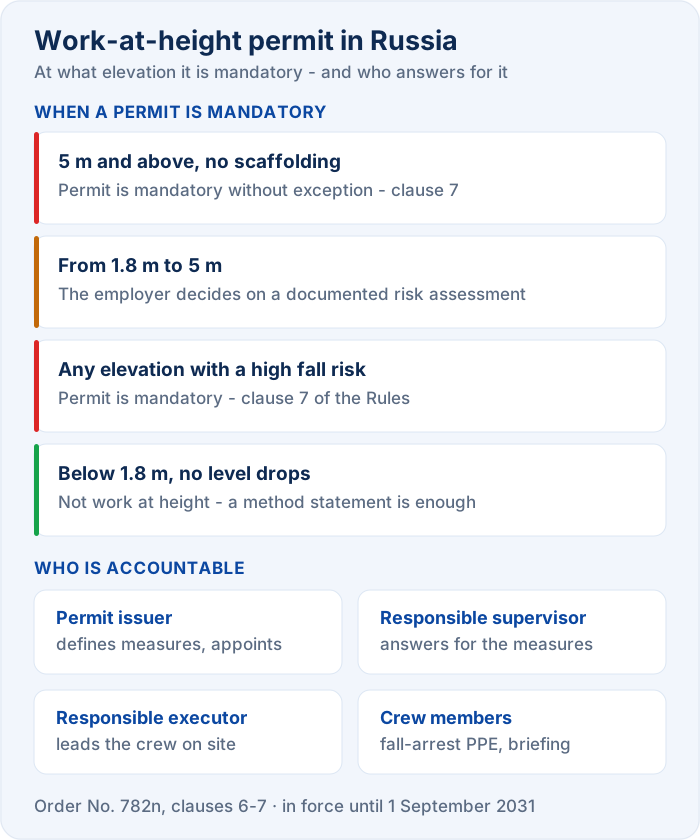
Height operations belong to the list of high-risk work under Order of the Ministry of Labour No. 776n. Under clause 7 of Order No. 782n, a permit is mandatory in the following cases:
| Category | Criterion | Basis |
|---|---|---|
| Elevated fall risk | Risk assessment identifies a high probability of a fall | clause 7 of the Rules |
| No scaffolding means | Elevation of 5 m or higher, without scaffolds, staging or towers | clause 7 of the Rules |
| Unguarded drops | Less than 2 m from the edge of a drop over 5 m, or guardrails below 1.1 m | clause 7 of the Rules |
| Weather restrictions | Wind 15 m/s or higher; thunderstorm; fog reducing visibility; ice | clause 45 of the Rules |
| Sail-like structures | Assembly or dismantling of structures with wind from 10 m/s | clause 45 of the Rules |
Before work begins, the employer must approve the List of height operations performed under a permit (clause 48 of the Rules). Every case from clause 7 must be included in it:
- The List itself — all cases from clause 7 plus any others added on the basis of the risk assessment.
- Operations exempted under clause 8 — the Rules require no second list for them. What they do require is that the safety measures be set out in method statements, occupational-safety instructions or work instructions, and that the arrangement be part of the employer's OHS (occupational health and safety) management system.
The List is approved by order of the employer and reviewed whenever conditions, equipment or technology change. Many organisations approve a second list of exempt operations as well: the Rules do not demand it, but it makes the clause-8 decision auditable.
In addition to clause 7, a permit is mandatory for work on unguarded roofs, for erecting or dismantling scaffolds, for rope-access systems, and for roofing work on sloped roofs (clauses 106, 144, 181, 250, 253, 273, 281, 283, 297, 303 of the Rules).
Related reading: «Permit-to-work activities: full 2026 list». «Permit for high-risk operations: categories».
3. At what height a permit is required
A common question from junior specialists: "At what elevation is a permit needed?" The answer: the decision is determined not by the absolute height but by the level of risk, the presence of barriers and the available means of scaffolding.
Work at height (clause 3 of Order No. 782n) covers any process with a risk of falling from 1.8 m or more. This includes: drops without barriers, platforms above machinery or water, climbing ladders steeper than 75° to above 5 m.
But a permit is not issued for every height task — only where the risk is elevated. Here is a clear overview:
| Elevation & conditions | Risk level | Permit required? |
|---|---|---|
| Less than 1.8 m, no drops | Not height work | No |
| From 1.8 m, guardrails from 1.1 m, minimal risk | Acceptable | May not be required (clause 8). A method statement suffices |
| From 1.8 m without barriers | Elevated | Based on risk assessment |
| From 5 m without scaffolding | High | Mandatory (clause 7) |
| Above 5 m, platform less than 2 m from drop edge | High | Mandatory (clause 7) |
| Any elevation with high risk per assessment | High | Mandatory (clause 7) |
Key threshold: 5 metres. Without scaffolding (scaffolds, staging, mobile towers) at 5 m or above, the document is mandatory without exception. Between 1.8 m and 5 m the employer decides based on the risk assessment.
A separate category — steeplejack work: above 5 m from ground, floor or deck, primary protection is the fall-arrest system. A permit is always required here.
Erecting and dismantling scaffolds, staging and towers is itself a height operation that typically also requires a permit.
Examples by sector
| Sector | Situation | Decision |
|---|---|---|
| Construction | Erecting steel framework at 12 m | Mandatory: above 5 m, no staging |
| Oil & gas | Tank servicing, platform with 1.3 m guardrail, regular crew | Not required if clause 8 conditions are met |
| Power engineering | Overhead-line repair on a pylon, rope access | Mandatory: clause 7 + rope access |
| Utilities | Snow clearing from a sloped roof without barriers | Mandatory: unguarded roof |
| Manufacturing | Replacing lamps on a bridge crane (14 m) from a cherry picker | Per risk assessment: cherry picker reduces risk level |
Two identical processes at the same height may or may not require a permit. It all depends on barriers, scaffolding and consistency of conditions.
How to assess risk in practice? Experts recommend the "probability × consequence" matrix method. Take a specific workplace and analyse: what is the probability of a fall (considering barriers, crew skills, task frequency) and how severe the consequences would be (depending on height, surface below, presence of fall protection). If the product falls in the "red zone", issue a permit. If in the "green zone", a method statement suffices. Document every decision: during an inspection the State Labour Inspectorate (GIT) will demand justification for why the risk was deemed acceptable.
See also: «Which work requires a permit: the full criteria».
4. Who issues the document: responsible officers
Safe performance of height operations under a permit requires the appointment of three categories of officers (clause 53 of the Rules):
| Role | Who is appointed | Group | Key duties |
|---|---|---|---|
| Issuer | Managers, specialists | 3rd | Defines the content: location, crew, measures. Fills in the form, issues two copies, registers in the logbook |
| Responsible supervisor | Managers, specialists | 3rd | Arrives on site in person. Checks crew readiness, PPE condition, rescue kit. Delivers the task briefing against signature. Gives permission to start |
| Responsible executor (foreman) | Brigade leaders, team leaders, qualified workers | 2nd | Leads the crew on site. Assigns each member their workplace, takes the crew out for breaks and at the end of the shift. Monitors PPE use |
All are appointed by employer's order. Each must complete training at a licensed educational centre.
Who bears the greatest legal liability? The issuer. They are personally responsible for the correctness, completeness and timeliness of the document. In the event of an accident, the first questions come to them — from the investigation commission and from the investigative authorities. Investigation practice shows that HSE engineers have received custodial sentences - not suspended ones - specifically because they signed a permit without checking the site. The issuer's liability is enshrined in clause 55 of the Rules and confirmed by extensive case law.
The supervisor must personally verify: the site is prepared, barriers are installed, safety systems are operational, the rescue kit is complete, signs are in place (clause 56(d) of the Rules). The word "personally" is key — one cannot sign the "site verified" line while sitting in an office.
The executor checks, in the presence of the responsible supervisor, that the workplaces are prepared and that the crew has the PPE named in the permit, assigns each member their workplace, and takes the crew out for breaks and at the end of the shift (clause 59 of the Rules). The task briefing is not theirs to give: that duty belongs to the responsible supervisor, and the crew signatures in the permit confirm exactly that briefing. No signature — no access. No exceptions.
Important nuance: Order No. 782n contains no rule on combining these roles at all — neither permitting nor prohibiting it. This sets height work apart from electrical installations, where the combinations are set out in table No. 2 to clause 5.13 of Order No. 903n. What the Rules do state (clause 58) is that the responsible executor is a member of the crew and carries out the responsible supervisor's instructions, and that an executor who has to leave the site temporarily may hand their duties to the responsible supervisor or to a worker authorised to issue permits — provided that person holds clearance matching the 2nd group. And if there is no one to hand over to, the same clause obliges the executor to remove the crew from the workplace - it may not be left without a responsible executor. The roles are therefore separated by function, while the decision on combining them rests with the employer and has to be justified.
When a contractor is engaged, an admission act from the host organisation is required together with agreed safety measures. As a rule, the permit is issued by the contractor, taking the client's requirements into account.
See also: «Who issues a permit: authority and liability», «Electrical work permit: officers and safety groups», «How a permit is issued and signed off».
5. Safety groups
Personnel authorised for height work under a permit are divided into three groups (clauses 13–15 of the Rules). Confusing them is not an option, because the group determines which functions a worker may perform.
| Group | Members | Requirements | Role | Knowledge test |
|---|---|---|---|---|
| 1st | Crew workers | Training + medical exam + certificate | Crew members, work under 2nd- or 3rd-group supervision | Annually |
| 2nd | Brigade leaders, foremen, internship supervisors | Same + at least 1 year of height-work experience | Executors (foremen) under a permit | Annually |
| 3rd | Managers, specialists | Age 21+, at least 2 years' experience | Issuers, supervisors, work-plan approvers, trainers, exam commission members | Training at least once every 5 years (clause 23); the employer sets how often knowledge is re-tested (clause 33) |
Training is conducted only by organisations holding an educational licence. Upon completion, a certificate (Annex 3) is issued specifying the group.
Extraordinary knowledge checks are ordered: when transferring to a different type of work, after a break exceeding one year, at the request of supervisory authorities, or when new regulations come into force.
Preliminary and periodic medical examinations are mandatory (Order of the Ministry of Health No. 29n of 28 January 2021). Personnel with medical contraindications for height work are not admitted.
Training cost and programme
| Parameter | 1st & 2nd groups | 3rd group |
|---|---|---|
| Theory | 16 hours | 24 hours |
| Practical training | 16 hours | Practical module |
| Cost | RUB 3 000 – 10 000 | RUB 8 000 – 15 000 |
| Upon completion | Exam + certificate | Exam + certificate |
A common mistake: specialists confuse "general occupational-safety training" with "training in safe methods for work at height". These are different programmes. Completing general OHS training (Government Decree No. 2464) does not replace specialised training under Rules 782n. Both are mandatory.
How to choose a training centre? Three things to look for. First: an educational licence (verifiable on the Rosobrnadzor website). Second: a practical training site with real equipment — fall-arrest systems, anchor lines, rescue-practice simulators. Third: the programme must comply with Rules 782n, not the outdated POT R M-012. There are known cases where training centres issued "certificates" based on superseded regulations. During an investigation, such a document has no legal force.
6. Crew composition
The document lists every crew member by name: surnames, initials, safety-group numbers, certificate numbers. Each confirms having received the task briefing by signature.
Minimum: two persons — an executor with at least a 2nd-group certificate and one crew member with at least a 1st-group certificate. There is no upper limit; it is determined by the scope and complexity of the task.
Rules for changing the crew
| Situation | Action | Reissuance |
|---|---|---|
| Replacing the executor (foreman) | Document is reissued in full | Yes |
| Replacing an ordinary crew member | Entry in the document + briefing | No |
| Who makes changes | Only the issuer or an authorised person | — |
| Multiple crews on one site | A separate document for each crew | — |
The task briefing is delivered by the responsible supervisor against the crew members' signatures in the permit (clause 56(g) of the Rules); the same person answers for its completeness and quality (clause 57(c)) and checks afterwards how well the crew absorbed it (clause 56(i)). It covers: the nature of the upcoming work, hazards on site, procedures for using PPE and safety systems, emergency actions, and evacuation routes.
See also: «Permit roles: who is authorised and accountable».
7. Organising height operations under a permit
The entire process comprises four sequential stages under Rules 782n. None may be skipped.
Stage 1. Documentation.
The employer approves the list of operations, appoints responsible officers by order, and arranges training. A work execution plan (WEP) or method statement is developed.
The WEP and the permit are interconnected. The WEP defines the technical side (how to perform the task safely): technology description, barrier and fall-protection layouts, anchor-device load calculations, rescue and evacuation plan. The permit defines the organisational side (who, where, when, with what measures). The WEP is approved by a 3rd-group specialist.
Stage 2. Personnel admission.
Only persons holding a certificate of the appropriate group, who have passed medical examinations and have been familiarised with the WEP and the permit, are admitted.
Stage 3. Site preparation.
The supervisor personally inspects barriers, scaffolding, safety systems, the rescue kit and signs. In practice this stage takes 20 minutes to an hour, depending on site complexity.
What exactly to check? Experienced specialists use the "five-point rule": barriers (height, attachment, stability), anchor devices (compliance with design loads, no corrosion), every crew member's PPE (next inspection date, integrity), the rescue kit (winch, lanyard, stretcher, first-aid kit), and safety signs plus access restrictions. If even one point is not in order, work must not begin.
Stage 4. Execution.
Each day before the shift, the executor inspects the site and checks PPE. Upon completion of the full scope of work, the document is closed with both parties' signatures.
What if several types of hazardous work are combined on site — for example, height and hot work? A single permit covering all processes and designating those responsible for each is permitted (clause 50 of the Rules). See also: «Hot-work permit: complete 2026 guide».
Detailed procedure from preparation to closing: «Permit-to-work in Russia: how the system works».
8. Filling out the form
The form follows Annex 2. Here is the full section structure:
| Section | Content | Points to watch |
|---|---|---|
| Header | Organisation, department, number, date | Sequential numbering per logbook |
| Responsible officers | Full names, positions of issuer, supervisor, executor | Include groups and certificate numbers |
| Location & scope | Exact reference: building, floor, elevation, axis | "Company premises" wording is unacceptable |
| Hazards | All hazardous and harmful factors on site | Including those that may arise during work |
| Dates | Start and end date and time | Maximum 15 calendar days (clause 65) |
| Materials | Tools, appliances, measurement instruments | Full list |
| Measures | Actions before and during work | Link each measure to a specific hazard |
| Protection systems | Restraint, fall-arrest, positioning, rope-access, rescue | Specify the GOST standard for each element |
| Special conditions | Weather limits, concurrent work, danger zones | Describe countermeasures |
| Crew | Full names, group, briefing signatures | No signature — no admission |
| Daily admission | Entry each shift | Date, time, executor's signature |
| Closing | Date, time, signatures | Both copies closed simultaneously |
Step-by-step procedure
- The issuer fills in all sections: defines the crew, measures and protection systems.
- Two copies are handed to the supervisor. The issuance is recorded in the logbook (number, date, task name).
- The supervisor arrives on site and checks readiness: PPE completeness, system operability, rescue-kit presence.
- The responsible supervisor delivers the task briefing to every crew member on site.
- The crew signs, confirming the briefing and familiarity with the conditions.
- The supervisor gives written permission to start.
- Each day before the shift the executor inspects the site and records the admission.
- Upon completion the document is closed with signatures. One copy is returned to the issuer.
Common mistakes when filling in the form
Inspection practice reveals six mistakes that state labour inspectors (GIT) and investigation commissions find most frequently:
| # | Mistake | Consequence |
|---|---|---|
| 1 | Vague location: "company premises" instead of a specific building, elevation, axis | The document may be declared invalid |
| 2 | Incomplete hazard list: level differences noted but nearby traffic, electrical installations or chemicals omitted | Additional violation during investigation |
| 3 | Pro-forma safety measures: "use PPE" without specifying systems, brands, standards | Classified as insufficient measures |
| 4 | Missing signatures of some crew members | Treated as admission without briefing |
| 5 | Corrections in the form (blots, strikethroughs) | Document is invalid |
| 6 | Expired permit: work continues after 15 (or 30) days | Classified as working without a document |
Step-by-step algorithm with examples: «Filling in the permit form: step by step». «Permit forms and types: 2026 classification».
9. Validity and storage
Deadlines are strictly regulated by clause 65 of the Rules. Full table:
| Parameter | Value | Basis |
|---|---|---|
| Maximum issue term | 15 calendar days from start date | clause 65 |
| Extension | Once, up to 15 calendar days from extension date | clause 65 |
| Total maximum | 30 calendar days (15 + 15) | clause 65 |
| During breaks | Remains valid until expiry | clause 65 |
| Storage after completion | 30 days, then destruction is permitted | clause 66 |
| Storage after an accident | 45 years with investigation materials | Order of Rosarkhiv No. 236 |
| Logbook storage | Not set by Rules No. 782n | clause 67 only prescribes keeping the logbook |
The document may be extended by the original issuer or another authorised person. After the maximum period, a new permit is issued. A second extension is not permitted.
Records are kept in the permit logbook. Records are kept in the log of work carried out under permits; a recommended template is given in Annex 5 to the Rules. Order 782n does not require the log to be bound and sealed - that requirement comes from the gas-hazardous work rules (FNP 528) and is carried over to height work out of habit. It records: the permit number, issuance date, task name, executor's surname, start and end date and time, and the signature of the person who closed the permit. The logbook may be maintained on paper or electronically (with a digital signature).
See also: «Permit validity: table by type».
10. Height operations without a permit
Not all height work requires a permit. Clause 8 of Order No. 782n allows even clause-7 operations to be performed without a permit, but only when all of the following conditions are met simultaneously:
| Condition | Explanation |
|---|---|
| Acceptably minimal fall risk | Documented risk assessment |
| Periodic repetition | Operations are part of the routine process |
| Consistent location and conditions | The nature of the work does not change |
| Collective protective equipment | Guardrails from 1.1 m, scaffolding, safety nets |
| Permanent crew of qualified workers | Trained, certified personnel |
| Procedure documented in the OHS management system | Formally recorded |
But if even one condition is breached (crew changed, guardrail removed, new hazard appeared), a permit is mandatory.
Clause 8 does not require a separate list of exempt operations. What it does require is that the safety measures be set out in method statements, occupational-safety instructions or work instructions, and that the arrangement be part of the employer's OHS management system. Without that, the exemption itself collapses and the work falls back under clause 7.
See also: «Which work requires a permit - and which does not».
11. Penalties and liability
Performing height work without a permit (when one is required), with documentation deficiencies, without an approved list, or with untrained personnel carries serious consequences. Here is a breakdown.
Administrative penalties (Article 5.27.1 of the Administrative Code)
| Basis | Official and sole trader | Legal entity |
|---|---|---|
| Part 1 - breach of occupational-safety requirements, general case; this is where working without a permit itself lands | warning or RUB 2 000 - 5 000 | warning or RUB 50 000 - 80 000 |
| Part 3 - admitting a worker without training, knowledge testing, a medical exam, a psychiatric assessment, or despite medical contraindications | RUB 15 000 - 25 000 | RUB 110 000 - 130 000 |
| Part 4 - failure to provide personal protective equipment | RUB 20 000 - 30 000 | RUB 130 000 - 150 000 |
| Part 5 - the same offences by a person already penalised for an analogous one | RUB 30 000 - 40 000 OR, instead, disqualification for 1-3 years (official) or suspension up to 90 days (sole trader) | RUB 100 000 - 200 000 or suspension up to 90 days |
The amount depends on which part the violation is classified under. Working without a permit itself falls under the general case (part 1); part 3 is added when someone was admitted to the work without training, knowledge testing or a medical examination - a frequent companion at height. For an official the gap between part 1 and part 3 is five- to sevenfold (RUB 2 000 against RUB 15 000 at the lower bound); for a company it is roughly twofold (RUB 50 000 against RUB 110 000).
Criminal liability (Article 143 of the Criminal Code)
| Outcome | Sanction |
|---|---|
| Grievous bodily harm | Fine up to RUB 400 000, community, correctional or forced labour, or imprisonment up to 1 year |
| Death of one person | Forced labour or imprisonment up to 4 years |
| Death of two or more | Forced labour or imprisonment up to 5 years |
Liability falls on the issuer, the supervisor and the head of the organisation. The employer cannot shed its safety obligations even by appointing ten responsible officers. This is confirmed by the Ministry of Labour's position and by case law.
What is examined during an investigation
In the event of a fall-related accident, the investigation commission first requests: the original permit (both copies), the logbook, the order appointing responsible officers, crew certificates, training records, medical examination results, the WEP or method statement, and the admission act (for contractors). The absence of any of these documents is classified as a violation.
The content is also analysed separately: whether the stated measures match the actual conditions on site, whether the task briefing was conducted, whether the executor recorded daily admissions. Pro-forma backdated completion is easily detected by forensic examination — and this shifts the situation from administrative to criminal liability.
Checklist: minimum documents for height work
Before the crew goes on site, verify that every item is in place:
| # | Document | Basis |
|---|---|---|
| 1 | Order appointing responsible officers | Order 782n |
| 2 | Approved list of permitted and non-permitted operations | clause 48 of the Rules |
| 3 | Completed and registered permit (two copies) | clause 54 of the Rules |
| 4 | WEP or method statement | Rules 782n |
| 5 | Certificates of all crew members with current knowledge tests | Annex 3 |
| 6 | Medical examination results (preliminary & periodic) | Order of the Ministry of Health No. 29n |
| 7 | Admission act from the host organisation (if a contractor is used) | Rules 782n |
| 8 | Log of work carried out under permits | Annex 5 (recommended template) |
| 9 | Rescue and evacuation plan | Rules 782n |
| 10 | PPE passports and certificates for fall-protection equipment | Rules 782n |
This checklist covers the requirements of Order 782n. Additional documents may be required under sector-specific regulations: Federal Norms and Rules for hazardous production facilities, POTEU (the Rules on Labour Protection when Operating Electrical Installations, Order No. 903n) for electrical installations, and organisational standards. Keeping electronic copies of all documents is recommended: they may be requested at any time during an inspection, and searching for paper originals in filing cabinets takes hours.
See also: «Penalties for working without a permit in Russia».

12. FAQ
For how long is a work-at-height permit issued?
Maximum: 15 calendar days from the start date. A single extension of up to 15 days is permitted. During breaks the document remains valid until expiry (clause 65 of the Rules).
Who has the authority to issue a work-at-height permit?
Managers and specialists holding a 3rd-group certificate, appointed by employer's order and trained at a licensed educational centre (clause 53 of the Rules).
Is a combined permit for height and hot work allowed?
Yes. When several types of hazardous work are performed simultaneously, a single document listing all processes and responsible officers is permitted (clause 50 of the Rules).
How long should a closed permit be kept?
30 days, after which destruction is permitted. If an accident occurred, the permit is kept in the company archive together with the investigation materials (clause 66 of the Rules); the 45-year retention period is set by Order of Rosarkhiv No. 236.
What are the penalties for operating without a permit at height?
Under Article 5.27.1 of the Administrative Code the amount depends on the part. General case (part 1): RUB 2 000 - 5 000 for an official and RUB 50 000 - 80 000 for a company. Admitting a worker without training, knowledge testing or a medical exam (part 3): RUB 15 000 - 25 000 and RUB 110 000 - 130 000. Repeat offence (part 5): up to RUB 40 000 with disqualification for up to 3 years, and up to RUB 200 000 for a company. In the event of severe consequences, criminal liability under Article 143 of the Criminal Code applies.