A welder has no right to strike an arc at a temporary workplace without a hot work permit. Period. Now the bad news: based on experience from inspections at oil refineries, construction sites and power facilities, roughly 70% of these documents contain errors. The most common issue is a vague description of the location. "Plant territory" instead of a specific workshop, elevation and column grid reference.
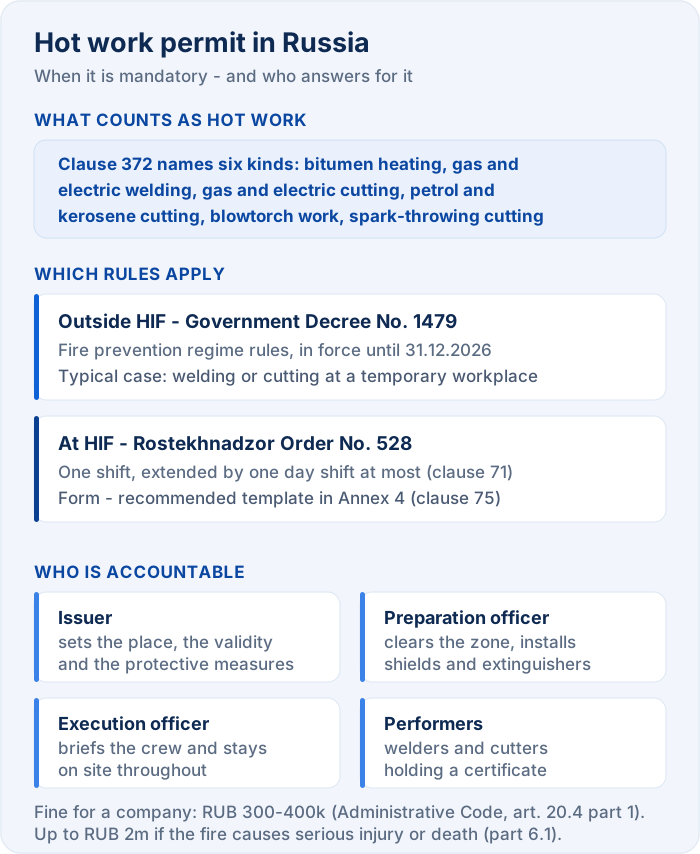
The penalty for failing to issue a permit: up to 400,000 roubles for a legal entity under Part 1 of Article 20.4 of the Code of the Russian Federation on Administrative Offences (hereinafter — the Code of Administrative Offences). If the violation causes a fire with property damage or minor injury, the ceiling is 800,000 roubles (Part 6); if the fire causes serious injury or death, it is 2,000,000 roubles (Part 6.1). Plus a criminal case under Article 219 of the Criminal Code.
This guide covers everything an occupational safety specialist, engineer or shop supervisor needs to know: which operations require a permit, who signs it, how to fill in the form correctly, how long to keep the document, and what liability applies for violations. A general reference on all permit types is available on the main page.
Contents
What a hot work permit is and why it mattersWhich operations count as hot work: full listWhen a permit is required — and when it is notWho issues and signs the documentThe form: structure, filling, typical mistakesProcedure: preparation, execution, closingValidity and storagePenalties and criminal liabilityFAQ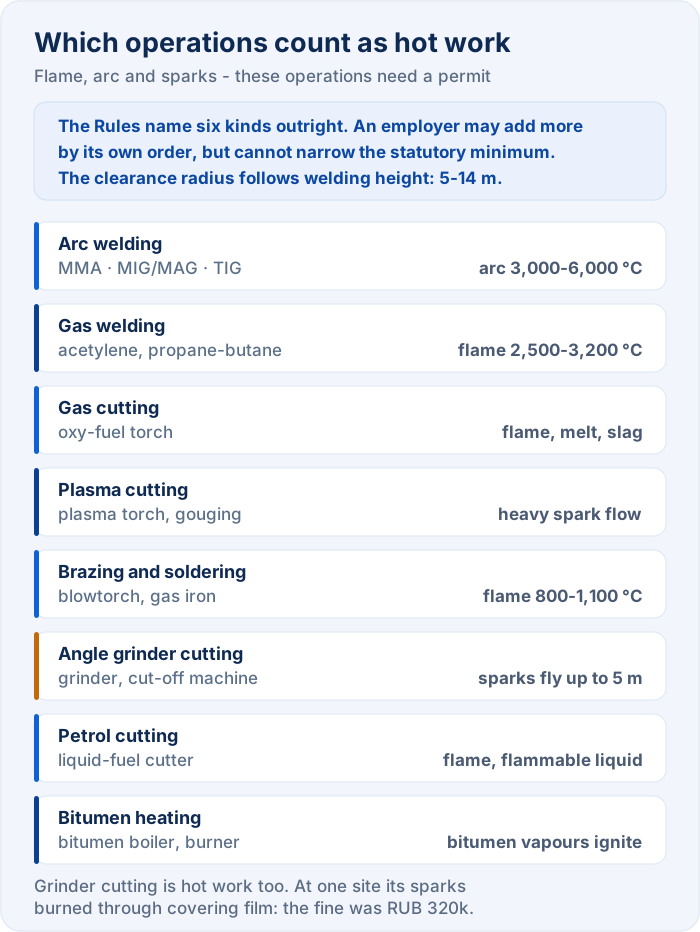
What a hot work permit is and why it matters
A hot work permit is, in essence, a written task authorisation from a manager. The document records: where exactly welding or cutting will be performed, at what time, with what equipment, who is responsible for preparing the site, who supervises the process, and what protective measures are mandatory.
The primary legal framework: the Fire Safety Rules of the Russian Federation, approved by Government Decree No. 1479 dated 16 September 2020 (hereinafter — the Fire Safety Rules). The document is in force until 31 December 2026. The latest amendments were introduced by Government Decree No. 90 dated 3 February 2025; as of August 2026 there is no later revision.
At hazardous industrial facilities (hereinafter — HIF), Rostechnadzor Order No. 528 dated 15 December 2020 applies in parallel. It approved the Federal Rules "Safe Conduct of Gas-Hazardous, Hot and Repair Work" (hereinafter — Order 528). A recommended form template is contained in Annex 4 to this order.
Three functions of the document
| Function | What is recorded | Correct example |
|---|---|---|
| Coordinates | Building, shop, floor, elevation, equipment | "Shop No. 3, elevation +6.000, column B-5" |
| Protective measures | Type and number of extinguishers, clearing area, shielding | "2 x OP-5 (powder extinguisher), 5 m clearance, 1.5 x 2 m shield" |
| Responsibility | Who issued, prepared, supervises, executes | Name + position + signatures |
A formality? No. Electric welding and gas cutting are consistently among the top three causes of industrial fires in Russia. Annual statistics from the Russian Ministry of Emergency Situations confirm: thousands of fires are linked to violations during fire-hazardous operations. A properly issued document reduces the probability of a fire and, in case of an incident, protects the employer legally.
Step-by-step algorithm for issuing all permit types: "Permit Issuance: Step-by-Step 2026 Guide».
Which operations count as hot work: full list
Clause 372 of the Fire Prevention Regime Rules names hot work operations one by one: open-flame heating of bitumen, gas and electric welding, gas and electric cutting, petrol and kerosene cutting, blowtorch work, and cutting metal with a powered tool that throws sparks. Clause 66 of Order 528 repeats the same list word for word.
Reference table for specialists issuing the permit:
| Category | Operations | Hazard factor | Hazard zone radius |
|---|---|---|---|
| Gas welding | Acetylene, propane-butane torch | Flame of 2500-3200 °C | 5 m |
| Arc welding | MMA (manual metal arc welding with coated electrodes), MIG/MAG (semi-automatic welding in shielding gas), TIG (argon arc welding) | Arc 3000-6000 °C, molten metal spatter | up to 10 m |
| Gas cutting | Oxygen, propane, acetylene cutter | Flame, molten metal, slag | 10 m |
| Plasma cutting | Plasma torch, air-arc gouging | Arc 15 000-30 000 °C, intense spark stream | 10 m |
| Petrol cutting | Liquid-fuel cutter | Flame, flammable liquid under pressure | 10 m |
| Brazing / soldering | Blow torch, gas soldering iron | Open flame 800-1100 °C | 5 m |
| Abrasive cutting | Angle grinder, abrasive cut-off machine | Sparks reaching up to 5 m, heating of workpiece | 5 m |
| Bitumen heating | Bitumen boiler, gas torch for mastic | Flame, flammable bitumen vapours | 5 m |
The list in the Rules themselves is closed. Six kinds of work are named outright, and an organisation cannot cut that minimum. It may extend it, though: by its own order the employer applies the permit to further operations. In practice, oil-and-gas enterprises add open-flame pipe heating, while shipyards include burning off old paint in tanks and compartments.
The angle grinder deserves a separate mention. It is arguably the most underestimated item on this list. Many engineers simply do not realise that cutting metal with an angle grinder is legally equivalent to hot work. A stream of sparks from an abrasive disc flies up to 5 metres. Spark temperatures reach 1500 °C. That is enough to ignite rags, oil-soaked overalls or thermal insulation. At one site sparks from a grinder burned through polyethylene film covering equipment. No hot work permit had been issued. The fine was 320,000 roubles.
Classification of all permit types: "Permit-to-Work: All 24 Categories". Permit types: "Types of Permits: Full 2026 Classification».
When a permit is required — and when it is not
The main criterion is simple: a hot work permit is issued for welding, cutting and brazing at temporary workplaces. This is established by clause 372 of the Fire Safety Rules.
| Location | Permit required? | Legal reference | Comment |
|---|---|---|---|
| Temporary location: repair bay, shop, open area | Yes, mandatory | cl. 372 of the Rules | Default case |
| Temporary location at HIF | Yes + additional measures | cl. 71 of Order 528 | Gas analysis, enhanced supervision |
| Category A and B explosion-fire hazard rooms | Yes + atmosphere control | cl. 354(d)-(e) of the Rules | Work stops once explosion-safe concentration limits are reached |
| Stationary welding post | No | cl. 372 of the Rules | Subject to exhaust ventilation and extinguishers |
| Construction site | No (under the Fire Safety Rules) | cl. 372 of the Rules | But requirements of Order 884n apply |
| Private household | No | cl. 372 of the Rules | For individuals |
What qualifies as a stationary post
A stationary post is an area that:
- is included in the organisation list by order of the manager,
- is equipped with local exhaust ventilation (the Rules set no specific capacity - it comes from the design and the equipment data sheet),
- is equipped with primary fire-extinguishing means.
Everything else counts as a temporary workplace. And it requires a permit.
Typical mistake in practice
A characteristic case: a plant equipped a repair area with two welding tables. No exhaust ventilation was installed, the area was not added to the list of stationary posts. Result: the State Fire Supervision inspector recorded welding at a temporary workplace without a permit. The fine under Part 1 of Article 20.4 of the Code of Administrative Offences was 300,000 roubles.
Fire-hazardous operations are simultaneously included in the indicative list of high-hazard work under Order of the Ministry of Labour No. 776n dated 29 October 2021 (Annex 2, items 11.1-11.6). This means additional obligations: a work execution plan, occupational risk assessment and a targeted briefing.
Read more: "High-Hazard Work Permit: Complete 2026 Guide". Liability for skipping it: "Penalties for Working Without a Permit in Russia».
Who issues and signs a hot work permit
Roles and duties differ depending on the category of the facility.
Ordinary facilities (Fire Safety Rules)
| Role | Who is appointed | Duties |
|---|---|---|
| Issuer | The head of the organisation or a person designated as responsible for fire safety (hereinafter — FS) | Fills in the form, defines the location, validity, protective measures |
| Person responsible for preparation | An engineering-technical worker (hereinafter — ETW) appointed by the issuer | Clears the zone, installs shields, places extinguishers |
| Person responsible for execution | An ETW appointed by the issuer | Conducts the targeted briefing, is continuously present on site |
| Performers | Welders and cutters with qualification certificates and a fire-safety tag | Execute the task strictly in accordance with the permit |
Hazardous industrial facilities (Order 528)
| Role | Who is appointed | Key duties |
|---|---|---|
| Approver | The head of the operating organisation or an official authorised by them (cl. 79) | Approves the document after it is agreed with the fire service (where one exists) and with adjacent subdivisions |
| Head of subdivision | Shop or installation manager | Briefs, approves extension, signs the "Admission" section |
| Person responsible for preparation | Subdivision ETW | Stops equipment, installs blinds, flushes pipelines |
| Person responsible for execution | Subdivision ETW | Monitors the gas-air atmosphere, keeps records |
| Performers | Persons over 18 who have passed medical exam and training | Perform welding and cutting strictly per the permit |
Contractors
Under contractor relationships, the document is issued by the contractor. The client issues an admission act and agrees on protective measures in its territory. A common situation: the contractor and the client confuse areas of responsibility. It is important to remember - the details of the admission act and the work execution plan are always included in the form.
Read more: "Who Issues a Permit: Authority and Responsibility". The system as a whole: "What a Permit to Work Is in Russia».
The form: structure, filling, typical mistakes
There is currently no single approved form for all organisations. The form from Annex 4 to Government Decree No. 390 lost legal force together with that decree as a whole on 1 January 2021, under Government Decree No. 1034 of 11 July 2020. The Rules in force contain no form as an annex at all: the required contents are listed in the text of clause 372. A company develops its own template, includes the details from clause 372 of the Fire Safety Rules and approves it by order. For HIF, a template is provided in Annex 4 to Order 528.
Form structure
| Section | What to fill in | How to do it correctly | Common mistake |
|---|---|---|---|
| Header | Organisation, subdivision, number, date | Through-numbering from the registration journal | Numbering reset to zero each month |
| Location | Building, shop, floor, column grid, elevation | "Shop 3, elev. +6.000, col. B-5" | "Plant territory" |
| Type of operation | Specific type of welding or cutting | "Manual arc welding (MMA), gas cutting" | "Hot work" |
| Responsible persons | Full name, position, signatures | Handwritten signatures of all persons | One person assigned to everything |
| Validity | Date, start and end time | At HIF: no more than one shift | Without specifying hours |
| Protective measures | Radius, type/number of extinguishers, shields | "2 x OP-5 at 2 m, 5 m clearance, 1x1 m fire blanket" | "Provide equipment" |
| Gas analysis (at HIF) | Concentration, time, instrument | "0.8% LEL (lower explosive limit), 08:15, SIGMA-1M" | Without specifying the instrument |
| Performers | Full name, grade, certificate number | Each worker on a separate line | Without certificate number |
| Targeted briefing | Signatures of each performer | Each performer signs personally | A single "covering" signature |
| Closing | Date, time, signatures | Both copies are closed simultaneously | Closed one, forgot the other |
Electronic format
Clause 82 of Order 528 allows the permit to be issued and registered as an electronic document - provided that unauthorised changes are impossible and storage is secured for one year from closing. The Rules do not prescribe a type of electronic signature: the organisation establishes whether one may be used in its own internal documents, under Federal Law No. 63-FZ of 6 April 2011 on Electronic Signatures. Implementation practice shows: the digital format solves three problems at once. Approval is faster, re-writing errors are eliminated, deadlines are tracked automatically. At enterprises that have switched to electronic systems, issuance time drops from 40 to 10-15 minutes.
What the inspector checks first
The "Protective measures" section. That is the first thing the State Fire Supervision inspector will open. Wording must contain specific figures: type and number of extinguishers, distance from the welding point, clearance area in metres, fire-blanket specification. Vague phrasing is grounds for a report.
The five most frequent mistakes
Experience from industrial-safety inspections reveals typical filling violations:
| № | Mistake | Why it is dangerous | How to fix |
|---|---|---|---|
| 1 | Location specified generically: "enterprise territory" | Unclear which area to clear and supervise | Specify shop, floor, elevation, grid axis, equipment |
| 2 | One person assigned for both preparation and execution | Physically impossible to prepare the site and supervise work at the same time | Appoint different ETWs or document the admissibility of combining roles by order |
| 3 | No welder certificate number | The inspector cannot verify qualifications | Enter number, grade, validity period |
| 4 | Measures written "from a template" | Specific site conditions are not taken into account | Each document must be individual |
| 5 | Permit not closed after completion | Formally the work continues, liability remains in force | Close both copies immediately after inspection |
Forms: "Russian Permit to Work Forms: Which Form for Which Work". Issuance algorithm: "Permit Issuance: Step-by-Step 2026 Guide».
Procedure: preparation, execution, closing
Three stages of work with specific actions and legal references.
Stage 1. Site preparation
The person responsible for preparation performs the measures in clauses 354-357 of the Fire Prevention Regime Rules. Mind the numbers: the fire-hazardous work section ends at clause 372, and clauses 373 onward already deal with petrol stations.
| Action | Details | Standard |
|---|---|---|
| Territory clearance | The radius depends on how high the welding point is: 5 m at floor level, 8 m at 2 m, 10 m at 4 m, up to 14 m above 10 m. The Rules set no flat "5 m for welding, 10 m for cutting" | cl. 356 of the Rules and Annex 5 |
| Shielding | Combustible structures to be protected with a metal shield, a fire-containment blanket or other non-combustible materials, and watered where needed | cl. 357 of the Rules |
| Opening closure | Hatches, ventilation and installation openings in floors, walls and partitions to be closed with non-combustible materials | cl. 356 of the Rules |
| Firefighting means | At least 2 extinguishers rated 2A, 55B and a fire-containment blanket | cl. 354(b) of the Rules |
| Atmosphere control | Monitor the vapour-gas-air mixture in the equipment and the hazard zone; stop work once explosion-safe concentration limits are reached | cl. 354(d)-(e) of the Rules |
Stage 2. Execution
The person responsible for execution is continuously on site. At HIF this is a direct requirement: clause 103 of Order 528 states that hot work must start and proceed in the presence of the work supervisor. The Fire Prevention Regime Rules contain no such clause - outside HIF continuous supervision is fixed by the permit itself and by the organisation own instructions. Not "checking in once an hour", but standing nearby. Accident-investigation practice shows: a few minutes without supervision are enough for sparks to reach insulation or unprotected structures. Result: fire, fine, investigation.
The welder starts work only after all preparatory measures are complete, the targeted briefing is conducted, and on personal instruction from the person responsible for execution. At any deviation (smoke, odour, change in the gas-air atmosphere) the work is stopped immediately.
Stage 3. Closing
Upon completion of hot work the responsible person inspects the site, heated structures and adjacent rooms. Clause 363 of the Rules requires the site to be watched for:
- no less than 2 hours - the same for every facility. The former split into 2 and 4 hours was removed by Government Decree No. 1885 of 24 October 2022, and the watch may now be remote, including by video camera.
- HIF have their own period: 4 hours of monitoring by the workers running the process (clause 105 of Order 528).
The performer extinguishes stubs and removes equipment. The responsible person enters the closing record and signs. The second copy is returned to the issuer.
Specifics for HIF
At hazardous industrial facilities, additional requirements are added to the standard procedure:
| Requirement | Essence | Legal reference |
|---|---|---|
| Gas analysis | Before starting and periodically during the work | Order 528 |
| Combination ban | Hot work and gas-hazardous work may not be combined in the same room, nor close by in an open area if fire- and explosion-hazardous substances may be released into the work zone | cl. 94 of Order 528 |
| Day-time regime | Day shift only. Two exceptions: containing or eliminating an accident under the emergency response plan, and - for urgent work - written permission from whoever approved the permit, with the fire service or a rescue unit present and extra measures written into the permit itself | cl. 68 of Order 528 |
| Age and qualifications | Performers at least 18, medical examination + training in the techniques and methods of the work | cl. 6 of Order 528 |
| Scheduled maintenance | Document for the whole maintenance period, extended daily by one work shift at most | cl. 71 of Order 528 |
Gas-hazardous permits: "Gas-Hazardous Work Permit: Requirements and Procedure". Issuance algorithm: "How to Issue a Permit to Work in Russia: Step by Step».
Combining with other types of work
In practice, hot operations are often combined with other hazardous activities. The paperwork procedure depends on the type of combination:
| Combination | What to issue | Legal basis |
|---|---|---|
| Welding + work at height | Two permits or a single combined permit | cl. 50 of Order of the Ministry of Labour 782n |
| Hot work + gas-hazardous (at HIF) | Combining is prohibited in the same room and close by in an open area where fire- and explosion-hazardous substances may be released; permits are separate | cl. 94 of Order 528 |
| Welding in electrical installations | Additional permit under Order of the Ministry of Labour 903n | Order of the Ministry of Labour 903n |
More on work at height: "Work-at-Height Permit: Complete 2026 Guide". Electrical installations: "Permit-to-Work in Electrical Installations: Order 903n Guide».
Validity and storage
One of the most common questions among OSH specialists: "How long is a hot work permit issued for?" The answer depends on the category of the facility.
| Parameter | Ordinary facility | HIF (Order 528) |
|---|---|---|
| Issue period | Recommendation: one work shift | Strictly one shift (cl. 71) |
| Extension | By agreement with the issuer | No more than one day shift (cl. 71) |
| Maximum validity | Determined by the organisation | Two shifts (main + extension) |
| If conditions change | Close + new document | Close + new document |
| Paper storage | One year after closing (art. 415, Rosarkhiv Schedule) | At least 6 months from closing (cl. 105) |
| Electronic storage | One year after closing (art. 415, Rosarkhiv Schedule) | One year from closing (cl. 82) |
| Filed with accident investigation records | 45 years | 45 years (art. 230.1 Labour Code) |
At HIF the permit is issued strictly for one shift. An extension is possible only under unchanged conditions confirmed by a repeat atmosphere analysis, and for no more than one day shift. For scheduled maintenance, the document is issued for the entire maintenance period, extended daily by one work shift at most (clause 71 of Order 528).
For facilities outside the HIF category, the Fire Safety Rules do not establish a strict one-day limit. However, methodological recommendations from the Russian Ministry of Emergency Situations point to daily re-issuance. The form contains rows for daily admission.
Outside HIF the retention period is not left to the company records schedule: it is set by article 415 of the Schedule of Standard Management Archive Records (Rosarkhiv Order No. 236 of 20 December 2019). Permits for work in areas with harmful and hazardous production factors are kept for one year after closing. The same article carries the exception: after an industrial injury, an accident or a fatality the period rises to 45 years, which matches article 230.1 of the Labour Code of Russia. The register of issued permits follows the same rule (article 416 of the Schedule).
When a permit is not required
A permit is not required in four cases. The fourth applies at HIF: work to contain and eliminate the consequences of an accident proceeds without a permit, under the emergency response plan, for as long as a direct threat to life, health, property or the environment remains (clause 69 of Order 528). The other three:
- Stationary welding post: a shop or area with exhaust ventilation, a non-combustible base and extinguishers. The post is included in the list by order of the manager. A separate limit in the Rules: there may be no more than ten permanent posts unless electricity and gas are supplied centrally (clause 361).
- Construction site: excluded by clause 372 of the Rules. However, Order of the Ministry of Labour No. 884n dated 11 December 2020 (Safety Rules for Electric- and Gas-Welding Work) establishes its own obligations: briefing, protective equipment, risk assessment.
- Private household: also excluded from clause 372 of the Rules.
Even without a formal permit, the employer is obliged to ensure safe conditions: fire safety instructions, ventilation, extinguishers, access only for certified welders.
Full list of works: "Permit to Work: All 24 Categories". Which operations require issuance: "Which Operations Require a Permit: Criteria and Examples».
More on validity: "Permit Validity: Table by Work Type».
Penalties and criminal liability
Welding without a permit (where one is required), with filling violations, without site preparation or with uncertified personnel: all of these are grounds for liability. Sanctions are divided into two categories.
Administrative fines (Code of Administrative Offences, as amended 23 March 2026)
| Violation | Article of the Code | Official | Sole trader | Legal entity |
|---|---|---|---|---|
| Fire-safety violation | Art. 20.4 part 1 | Warning or RUB 20,000 - 30,000 | Warning or RUB 40,000 - 60,000 | Warning or RUB 300,000 - 400,000 |
| Same under a special fire regime | Art. 20.4 part 2 | RUB 30,000 - 60,000 | RUB 60,000 - 80,000 | RUB 400,000 - 800,000 |
| Fire causing minor or moderate injury, or property damage | Art. 20.4 part 6 | RUB 80,000 - 100,000 | RUB 90,000 - 110,000 or suspension up to 30 days | RUB 700,000 - 800,000 or suspension up to 30 days |
| Fire causing serious injury or death | Art. 20.4 part 6.1 | No offence defined for officials | No offence defined for sole traders | RUB 1,000,000 - 2,000,000 or suspension up to 90 days |
| OSH requirements violation | Art. 5.27.1 part 1 | Warning or RUB 2,000 - 5,000 | Warning or RUB 2,000 - 5,000 | Warning or RUB 50,000 - 80,000 |
Criminal liability (Criminal Code of the Russian Federation, hereinafter — CC RF)
| Consequences | Article of the CC RF | Maximum sanction |
|---|---|---|
| Serious injury to a worker through negligence | Art. 143 part 1 | Fine up to RUB 400,000, or 180-240 hours of mandatory labour, or corrective labour up to 2 years, or forced labour or imprisonment up to 1 year |
| Death of one worker through negligence | Art. 143 part 2 | Forced labour or imprisonment up to 4 years |
| Death of two or more workers through negligence | Art. 143 part 3 | Forced labour or imprisonment up to 5 years |
| Fire causing serious injury through negligence | Art. 219 part 1 | Fine up to RUB 80,000, or restriction of liberty, or forced labour or imprisonment up to 3 years |
| Fire causing the death of one person | Art. 219 part 2 | Forced labour or imprisonment up to 5 years |
| Fire causing the death of two or more people | Art. 219 part 3 | Forced labour up to 5 years or imprisonment up to 7 years |
Article 219 of the CC RF (violation of fire-safety requirements) is especially relevant for hot work: ignition is a direct consequence of violations of fire-hazardous operation rules. The article addresses whoever bore the duty to observe fire-safety requirements - in hot work that is normally the permit issuer and the person responsible for execution.
Read more: "Who Issues a Permit: Authority and Responsibility».

FAQ
How long is a hot work permit issued for?
At HIF: strictly one work shift with the right of a single extension for one day shift (clause 71 of Order 528). Outside HIF, the Fire Safety Rules do not establish a strict limit, but the form contains rows for daily admission. Read more: "Permit Validity: Table by Work Type».
Who signs a hot work permit?
Outside HIF clause 372 of the Rules separates two acts: the permit is DRAWN UP by the head of the organisation or the person responsible for fire safety, and APPROVED by the head or another official authorised by them; it is issued to the work supervisor. At HIF the permit is drawn up by the head of the operating organisation or the person responsible for fire safety (clause 75 of Order 528) and approved by the head or an official authorised by them, after it is agreed with the fire service (clause 79). Read more: "Who Issues a Permit: Authority and Responsibility».
Where to get a hot-work permit template?
The HIF template is contained in Annex 4 to Order 528. For other organisations there is no approved form: Government Decree 390 together with its Annex 4 lost legal force on 1 January 2021. The organisation develops its own template, includes the details listed in clause 372 of the Rules, and approves it by order. Read more: "Russian Permit to Work Forms: Which Form for Which Work».
How long to keep a closed hot work permit?
At HIF both copies are kept for at least six months from closing (clause 105 of Order 528), and an electronic permit for one year from closing (clause 82). If the document ends up in accident investigation records, the employer keeps them for 45 years (article 230.1 of the Labour Code of the Russian Federation). At ordinary facilities it is one year after closing, under article 415 of the Rosarkhiv Schedule (Order No. 236 of 20 December 2019). Read more: "Permit Validity: Table by Work Type».
Can hot work be performed without a permit?
Yes, in three cases: at a stationary welding post (included in the list by order, equipped with exhaust ventilation and extinguishers), at construction sites and in private households. In all other situations a permit is mandatory. Read more: "Which Operations Require a Permit: Criteria and Examples».