Smart Permit electronic system: ready-made templates for all types of work, electronic signature, automatic log, deadline reminders. Save up to 70% of permit processing time. A single document in Excel takes 40 minutes. In Smart Permit: 3 minutes.
Roughly one permit in three that reaches a Russian labour inspector has a defect on its face. Not a spelling slip. A crew member who is on site but not on the paper, a safety section that says "observe safety rules" instead of naming a control, an appointment order that expired last spring. Each of those makes the permit challengeable, and a challengeable permit is worth nothing on the day it matters.
This guide walks you through the whole cycle, from choosing the blank to closing the document and logging it. It is written for expatriate health, safety and environment (HSE) managers and foreign contractors who already run a permit system somewhere else and now have to make it survive a Russian inspection. If you are new to the concept itself, start with what a Russian permit to work is and come back here. If you are not sure your job needs a permit at all, the criteria are set out separately.
What has to exist before you issue a single permit?
Half of permit issuance happens before anyone picks up a pen. Russia treats the permit as the last link in a chain of employer decisions, and an inspector reads the chain backwards: the permit points to an appointment order, the order points to a list of high-risk work, and that list points to a rule.
| What must be in place | What it actually is | Where it comes from |
|---|---|---|
| List of high-risk work | Approved by the employer before work starts, and it must include the jobs the rules themselves name (which ones) | Order No. 776n, Annex 2; the sector rules for your work |
| Appointment order | A signed order naming who may issue permits, who may act as responsible manager, supervisor, admitting officer | Employer's own order, required by the sector rules |
| Method statement | Written where the sector rules demand it; one statement may cover combined work | Order No. 782n for work at height, and equivalents |
| Blank form and register | The form comes from an annex to the rules, or the employer approves one where no annex exists | Order No. 903n, Annexes 7 and 8 |
| Trained people | Certificates and knowledge-check records for everyone named on the permit | Sector rules plus the training regulations |
Miss the first row and nothing downstream is valid. No list means no basis to issue, however neat the paperwork looks. On oil and gas sites this is the single item foreign contractors assume the client has taken care of, and the one nobody can produce when asked.
Who may sign a permit, and who may not?
Russian rules do not let a job title carry authority by itself. Authority comes from being named in a current order. Order No. 903n, clause 5.1, gives the clearest statement of the organisational measures that make work safe, and it is worth reading as a description of the whole cycle rather than an electrical rule:
- authorising the work by permit, by verbal instruction, or through the list of routine operations;
- granting permission to prepare the workplace and to admit the crew;
- admission to work;
- supervision while work is under way;
- recording breaks, transfer to another location, and completion.
That clause was written for electrical installations. Do not lift it word for word onto a scaffold or a vessel, because those have their own acts and their own vocabulary. Read it instead as the shape the cycle takes everywhere: five stages, each closed by a different person and a different signature. Nothing rolls over on its own.
The roles themselves divide like this.
| Role | Appointed by | Does what | Must be |
|---|---|---|---|
| Issuer | The employer's order | Sets the scope, the crew and the controls; fills the blank; closes it at the end | A manager or specialist with current training and a knowledge check |
| Responsible manager | Named on the permit by the issuer | Checks that site preparation and the control measures are complete; accepts the prepared site | A manager or specialist, appointed for complex or combined work |
| Work supervisor | Named on the permit by the issuer | Runs the crew on site and holds the line on the controls. The targeted briefing is given by the responsible manager under clause 56(g) of Order No. 782n; in electrical installations the work supervisor briefs the crew at the workplace (clause 6.32 of Order No. 903n) | Trained for this class of work |
| Admitting officer | Depends on the class of work | Verifies the controls physically exist, admits the crew, signs the time of admission | Knows the plant, the schemes and the process |
| Crew members | Entered on the permit by the supervisor | Do the work, report defects and breaches | Trained, medically cleared, briefed |
More on how these roles shift between rule sets is in the article on which work needs a permit at all.
The seven steps of issuing a Russian permit
Everything above is preparation. What follows is the permit itself, from blank form to closed document. Seven steps, in this order, every time.
The home page counts nine because it also counts the two prerequisites above, the approved list of high-risk work and the appointment order. From the blank form onwards, the sequence is these seven.
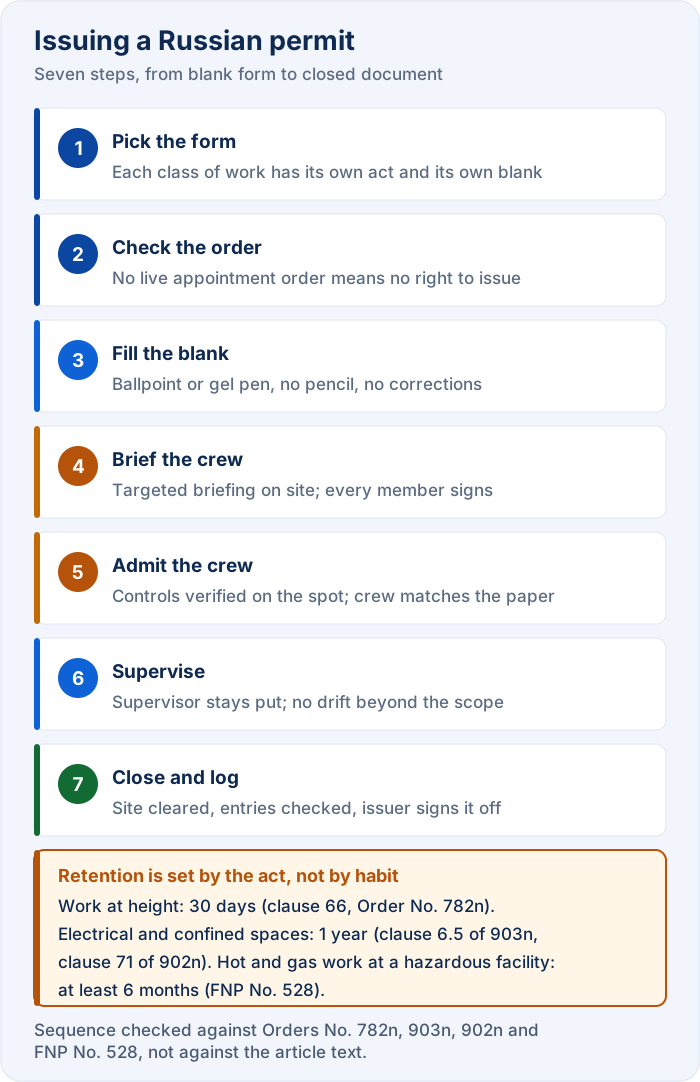
The seven steps, with the retention period each act sets. Print on A4 and pin it by the permit desk.
Step 1. Which work is it, and which form does it demand?
There is no universal Russian permit form. Each class of work has its own act, and each act carries its own approved blank. Using another sector's blank is not a formality; it is the reason a permit gets thrown out.
| Class of work | Act with the approved form | Where the form sits |
|---|---|---|
| High-risk work in general | Order No. 833n | Annex 1, a recommended sample |
| Work at height | Order No. 782n | Annex 2 |
| Electrical work | Order No. 903n | Annex 7 |
| Hot work at a hazardous production facility | Rostekhnadzor Order No. 528, a federal norm and rule (FNP) | Annex 4 |
| Gas-hazardous work at a hazardous production facility | Rostekhnadzor Order No. 528 | Annex 2 |
| Confined and enclosed spaces | Order No. 902n | No form given; the employer approves one |
Two rows deserve a warning. Order No. 833n governs the siting, installation, maintenance and repair of process equipment, and its Annex 1 is a recommended sample rather than a mandatory form. Many employers adopt it as the house template for high-risk work that no sector rule covers, which is reasonable, but its safety-measures field is one undifferentiated box with no column for a deadline or a named person. You will have to add those columns yourself. And Order No. 902n gives no form at all for confined spaces, so the employer's own approved blank is the only lawful document there.
Step 2. Check the appointment order is still alive
This is the step people skip, and it is the cheapest one to check. Before you issue, confirm the employer's order naming responsible persons is current. The order should carry:
- names and job titles of everyone entitled to issue permits;
- the classes of work each of them may cover;
- names and job titles of responsible managers and work supervisors;
- what happens when a named person is absent.
No live order means no right to issue. An expired order means the same thing. Check the date every time. It takes ten seconds and it is the difference between a permit an inspector accepts and one that turns into a finding.
Step 3. How do you fill the blank so it survives an inspection?
The issuer fills the form, in ballpoint or gel pen, legibly. No pencil, no corrections, no scraping out. Make a mistake and you write a fresh copy. Here is what each block wants.
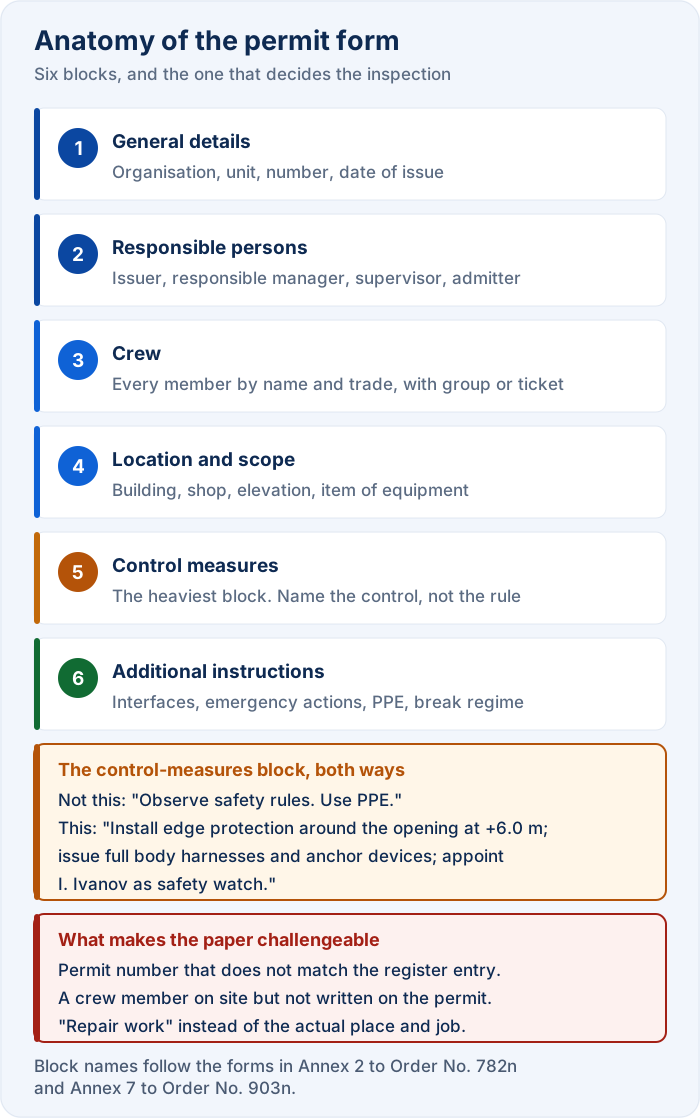
Six blocks of the form, the control-measures block written both ways, and the three defects an inspector looks for first.
General details. Organisation, department, permit number, date of issue. The number must match the register entry. Mismatched numbers are a classic finding, and an easy one for an inspector to spot.
Responsible persons. Names and titles of the issuer, responsible manager, work supervisor and admitting officer. For electrical work, add each person's electrical safety group.
Crew. Every member by name, with trade or job title. Electrical work needs the approval group; work at height needs the certificate number.
Location and scope. Precise. Building, shop, section, elevation, item of equipment.
Write it like this: "Replace the DN300 valve on the steam line in Shop 5, elevation +12.0 m." Not like this: "Repair work." The second version tells nobody where the crew is or what they are doing, and a permit written that way is treated as defectively issued.
Control measures. This block carries more weight than any other. Note that the forms in Orders No. 782n and No. 883n and in the annexes to FNP No. 528 have a separate field for measures during the work, and the site-handover certificate in Order No. 833n adds a table for measures after it.
Not this: "Observe safety rules. Use PPE."
This: "Install edge protection around the floor opening at elevation +6.0 m; issue full body harnesses and anchor devices to the crew; appoint I. Ivanov as safety watch."
Additional instructions. Interfaces with operations, emergency actions, extra protective equipment, the working and rest regime.
The permit is issued in two copies, one for the issuer and one for the work supervisor. If a contractor is involved, a third copy usually goes to the client's admitting officer. The exact number is printed in the note under the form.
Step 4. What must the targeted briefing cover?
The targeted briefing happens on the job, before work starts, and the work supervisor normally gives it. It is not a repeat of induction training. It is about this task, this site, today.
It has to cover the nature and volume of the work, the hazards present at that spot, the control measures written on the permit, the boundaries of the work area and any exclusion zones, how to use the personal protective equipment (PPE) issued, and what to do if something goes wrong.
Every crew member signs the permit to confirm they were briefed. Anyone who was not briefed, or who will not sign, does not go to work. There is no version of this step that happens in an office.
Step 5. What happens at admission?
The admitting officer, or the work supervisor where the rules give no separate admitting role, does five things at the workplace itself:
- Confirms that every control measure written on the permit physically exists.
- Checks the crew present against the crew listed. Everyone standing there must be on the paper.
- Confirms each person has the right protective equipment and that it works.
- Shows the crew the boundaries, the hazardous zones and the escape routes.
- Enters the date and time of admission and signs.
Work starts at that signature and not before. The clock written there is the clock that matters later, so it is also where the validity period starts running.
Step 6. Someone has to watch the job while it runs
The work supervisor stays at the workplace for the duration. That is the rule, and it is the part that erodes first on a busy site. The supervisor watches each crew member, holds the control measures in place, and refuses any drift beyond the scope on the permit. Spot a breach and the work stops and the crew comes out; the paperwork is sorted afterwards.
The responsible manager visits periodically and checks that reality still matches the permit. How often depends on the work. Nobody sets a number, which means the honest answer is: often enough that a change in conditions cannot run for hours unnoticed.
Step 7. How do you close a permit properly?
Closing is a sequence, not a signature.
- The supervisor takes the crew off the site.
- They inspect it: materials and tools cleared, scaffolds struck, openings covered, equipment shut down.
- They record completion with date and time, and sign.
- They hand the closed permit back to the person who issued it, directly or through the operations staff, depending on the rules.
- The issuer checks the entries and closes the document with their own signature.
Then it goes to file. There is no single retention period in Russia. Permits for work at height are kept 30 days under clause 66 of Order No. 782n. Electrical and confined-space permits are kept a year under Orders No. 903n and No. 902n. Gas-hazardous and hot work at a hazardous production facility are kept at least six months under Rostekhnadzor Order No. 528. Where no rule says otherwise, the general archive term is a year, set by item 415 of the Rosarkhiv retention schedule. If there was an accident, the permit goes into the investigation file and is kept 45 years, under the same item 415 of the Rosarkhiv schedule.
Register the issue and the closure. An unregistered permit looks, to an inspector, exactly like a permit that never existed.
How does this compare with a UK or US permit system?
Most of the mechanics will feel familiar to anyone who has run a permit desk under a UK-style safe system of work or an OSHA-driven programme. The differences are worth naming, because they are where imported procedures break.
| Russia | UK practice | US practice | |
|---|---|---|---|
| Source of the form | Prescribed by the act governing that class of work | Company procedure under a general legal duty | Company procedure, with prescribed content for confined space and hot work |
| Who may sign | Only a person named in a current employer order | Competent person as defined by the company | Qualified or authorised person as defined by the standard |
| Form content | Fixed by the annex; deviating from it weakens the permit | Designed by the company to suit the hazard | Content requirements set by standard, layout free |
| Regulator's angle | Compliance with the act, checked document by document | Adequacy of the safe system of work | Compliance with the specific standard cited |
The practical consequence is blunt. A global permit template that works in Aberdeen or Houston will not pass here on its own merits, because the Russian inspector is not asking whether your system is sound. They are asking whether this document matches the annex. Run your corporate template as an internal layer if you want, but the document that goes in the file has to be the Russian form.
Where do foreign contractors get this wrong?
Four failures repeat, in this order.
Signing without being named. A visiting HSE lead signs as issuer because that is their role at home. In Russia that signature carries no authority unless the client's or the contractor's own order names them, and the permit is defective from the moment it is written.
Copying yesterday's controls. The safety section gets duplicated from the previous permit for a similar job. It reads plausibly and describes a workplace that no longer exists. This is the failure that hurts people, not just files.
Crew drift. A fitter joins after admission and is not entered on the permit. If anything happens to that person, they were working without authorisation, and so was everyone who let them.
Treating closure as admin. The job finishes on Friday, the permit gets closed on Monday, and the register entry is written from memory. Every date on that document is now wrong, and it is the dates that an investigation reads first.
Penalties are pinned to the safety rule that was broken, not to the missing paperwork itself, which is covered in detail in the article on what a missing permit costs. Under part 1 of Article 5.27.1 of the Code of Administrative Offences a first breach brings either a warning or a fine of 50,000 to 80,000 RUB (~$591-946) for a company. A repeat breach moves the case to part 5: 100,000-200,000 RUB (~$1,183-2,366), or suspension of operations for up to 90 days.
Can the permit be electronic?
Yes, where the governing rules allow it and the signatures meet what that act asks for. There is no single national answer. Clause 1.5 of Order No. 903n accepts an electronic signature or any other method that identifies the worker, clause 6.6 of the same act lets both the permit and the register be kept electronically, and clause 67 of Order No. 782n makes the use of an electronic signature a matter for the employer's internal documents.
An electronic permit has real advantages: the register updates itself, expiry can trigger an alert, and nobody loses the second copy. The problem is evidential. During an inspection you must be able to show that the record could not be altered after the event, and a PDF in a shared folder does not demonstrate that. A scanned image of a signature identifies nobody and fails on any reading of the rules. Until you can prove immutability and signature validity, the paper original remains the safer artefact, and plenty of Russian sites run both.
What does the whole thing cost in time?
Thirty to forty minutes for a routine job on a prepared site with a standing crew. Most of a shift when the work needs a method statement, isolation performed by another department, or a contractor interface with a client's admitting officer. How long the finished permit then stays valid is a separate question, answered in the article on permit validity periods.
That gap is worth planning for. Teams that treat permit issuance as a five-minute formality before the shift are the ones that end up signing the paper after the crew is already working, which is precisely the sequence that turns a good day into an investigation.
Frequently Asked Questions
How long does it take to issue a permit to work in Russia?
Between 30 minutes and several hours. A routine job with a standing crew and a prepared site takes about half an hour. Work that needs a method statement, isolation by another department or a contractor interface takes most of a shift, because each approval waits for a signature from a different person.
Can one person hold two roles on the same permit?
Sometimes, and only one extra duty at a time. Clause 5.13 of Order No. 903n lets a responsible person take on one additional duty from its Table No. 2, never two at once. The person who issues the permit may also act as responsible manager, and a responsible manager may also act as work supervisor. A work supervisor takes on the admitting officer's duties only where the act allows it. Table No. 2 gives the general case: an installation with a simple single-line diagram, or a supervisor holding group IV in the situations of clause 42.5. The line cases are narrower and not the same as each other: on overhead lines the condition is that preparing the site means checking absence of voltage and fitting portable earths, while on cable lines it is fencing and warning signs, with the disconnection and earthing already done by operational staff.
Must the permit be handwritten, or can we use a computer?
Both exist. The paper original is filled in with a ballpoint or gel pen, no pencil, no corrections. An electronic permit is lawful where the governing rules say so, and those rules differ on signatures: clause 1.5 of Order No. 903n accepts an electronic signature or any other method that identifies the worker, while clause 67 of Order No. 782n leaves the choice to the employer's own documents. Read your act first. In an inspection the burden is on you to show the electronic record cannot be edited after the fact.
What happens if the work turns out bigger than the permit says?
You stop. The scope written on the permit is the boundary of the authorisation, not a suggestion. Extra work needs a new permit, which means a new briefing and a new admission. Widening the job under the old paper is one of the fastest ways to turn an accident into a criminal case.
Who physically keeps the permit while work is running?
The permit is issued in two copies. One stays with the person who issued it, the other is held by the work supervisor at the site. A third copy goes to the client's admitting officer when a contractor is involved. The exact count is printed in the note under the form in the governing rules.
Sources
- Ministry of Labour Order No. 903n of 15.12.2020 (Occupational safety rules for the operation of electrical installations; clause 5.1 organisational measures, Annexes 7 and 8)
- Ministry of Labour Order No. 782n of 16.11.2020 (Occupational safety rules for work at height; clauses 65 and 66, permit form in Annex 2)
- Ministry of Labour Order No. 833n of 27.11.2020 (Occupational safety rules for the siting, installation, maintenance and repair of process equipment; Annex 1 recommended permit form, Annex 2 site-handover certificate)
- Ministry of Labour Order No. 776n of 29.10.2021 (Model regulation on the occupational safety management system; Annex 2 indicative list of high-risk work)
- Ministry of Labour Order No. 883n of 11.12.2020 (Occupational safety rules for construction, reconstruction and repair; Annex 2 permit form with a separate table of measures during the work)
- Ministry of Labour Order No. 902n of 15.12.2020 (Occupational safety rules for confined and enclosed spaces)
- Rostekhnadzor Order No. 528 of 15.12.2020 (FNP "Rules for the safe conduct of gas-hazardous, hot and repair work"; permit forms in Annexes 2, 4 and 5)
- Article 5.27.1 of the Code of Administrative Offences (breach of state occupational safety requirements)
- Federal Archival Agency Order No. 236 of 20.12.2019 (schedule of standard management records and their retention periods; item 415 covers permits to work)
- Article 214 of the Labour Code of the Russian Federation (employer duties in occupational safety)

Smart Permit electronic system: ready-made templates for all types of work, electronic signature, automatic log, deadline reminders. Save up to 70% of permit processing time. A single document in Excel takes 40 minutes. In Smart Permit: 3 minutes.