Smart Permit electronic system: ready-made templates for all types of work, electronic signature, automatic log, deadline reminders. Save up to 70% of permit processing time. A single document in Excel takes 40 minutes. In Smart Permit: 3 minutes.
Send a crew into a switchroom without a permit and you carry two risks at once. One is a shock injury. The other is legal: an occupational safety breach costs a company 50,000 to 80,000 RUB, admitting an untrained worker costs up to 130,000 RUB, and a repeat offence up to 200,000 RUB, and if someone is hurt the case moves to Article 143 of the Criminal Code.
This guide is written for HSE managers and foreign contractors working in Russia. It covers the whole cycle: when the permit is required, who may sign it, which safety groups you need, how to fill in the form under Ministry of Labour Order No. 903n, how long it lasts, and what a breach costs. If the Russian system is new to you, start with the overview of what a permit to work is in Russia.
1. What the electrical permit-to-work is and why it matters
The permit is a written task that fixes the scope, the place, the start and end time, the safe conditions, the crew and the people in charge. That is the wording of clause 4.1 of the occupational safety rules for electrical installations, set by Ministry of Labour Order No. 903n of 15.12.2020. The recommended form is Annex 7 to those rules.
If you run a permit-to-work (PTW) system under OSHA or an IEC or ISO standard, the idea will be familiar. Russia, though, writes far more of it into law: the form, the roles and the qualification ladder are all set by the act, not by your own company procedure.
What the permit has to record
The document does three jobs at once.
- It records the scope and the place, using the dispatcher's own names for the installation, the connections and the equipment, and the voltage (clause 6.24).
- It lists the steps that make the site safe: isolate, prove dead, earth, post safety signs, set barriers.
- It names a person for each duty - the issuer, the responsible manager, the admitting officer, the work supervisor and the crew members.
A crew, by the definition in clause 4.1, is two people or more, the work supervisor included.
How many copies
Two copies are made: one for the work supervisor (or the safety attendant), one for the admitting officer. Three are made when the permit is passed on by telephone, radio, fax or electronic document - except where the work supervisor is also the admitting officer (clause 6.1). The permit may be completed by hand, on a computer, or wholly in electronic form with an electronic signature (clause 6.6).
2. Legal basis: Order 903n, PTEEP and related acts
| Act | Number and date | Scope | Status |
|---|---|---|---|
| Occupational safety rules for electrical installations | Min. of Labour Order No. 903n of 15.12.2020 (rev. 29.04.2025) | Occupational safety: permits, safety groups, responsible persons, technical measures | In force until 01.09.2031 |
| PTEEP - Rules for the Technical Operation of Consumers' Electrical Installations | Min. of Energy Order No. 811 of 12.08.2022 | Technical operation of consumer electrical installations: owner duties, staff categories | In force since 07.01.2023 |
| Model regulation on OSH management | Min. of Labour Order No. 776n of 29.10.2021 | Annex 2: sample list of high-risk work, electrical work included | In force |
| Training and briefing procedure | Gov. Decree No. 2464 of 24.12.2021 | Clause 19(a): targeted briefing before any work that needs a permit | In force |
How 903n and PTEEP fit together
The two main acts do different jobs. Order 903n is the occupational safety act: how to set the work up, which groups you need, which technical and organisational steps to take. PTEEP, or Order 811, is the technical act: how to keep the plant in order, which staff categories you must have, how an installation is commissioned. For a permit, 903n is the one that counts, and PTEEP applies on top of it.
Crews arriving from abroad sometimes read PTEEP as the safety basis. It is not, and building your permit procedure on it will leave gaps.
3. Three ways to organise the work
Clause 4.1 of Order 903n gives three forms: a permit to work, a written instruction (Russian: rasporyazhenie), or a standing list of routine-operation tasks. The permit is the strictest of the three and is kept for the riskiest jobs; the family of Russian permits, and where the electrical one sits in it, is mapped in the guide on permit-to-work categories.
The middle form is worth a clear word, because it is often mistranslated. A rasporyazhenie is not a verbal order: clause 7.1 defines it as a written task setting out the content, the place, the time, the safety measures and the workers assigned, with their safety groups. It may be passed on by telephone or radio, but then it is logged in two registers - the one kept by the worker who gave it and the one kept by those who received it - with signatures in both (clause 7.1). What separates it from a permit is that it is one-off, and it lapses at the end of the working day or shift.
| Form | Risk level | Validity | Example |
|---|---|---|---|
| Permit to work | High | Up to 15 calendar days (1 day if live) | Major repair of a 10 kV transformer |
| Written instruction | Medium | Working day / shift | Replacing fuses in switchgear up to 1000 V |
| Routine operation | Low | Per the approved list | Cleaning and wiping equipment enclosures |
When the permit is mandatory
There is one thing worth knowing before you look for a list: Order 903n has no single consolidated table of jobs that need a permit. The requirement is spread across the rules, clause by clause, and each of the jobs below is named in its own clause.
| Work | Clause of Order 903n |
|---|---|
| Use of lifting appliances and machinery in a live installation | 45.1 |
| Testing equipment with a mobile test set | 39.2 |
| Cleaning insulation and live parts without removing voltage | 40.7 |
| Work in underground cable structures, minimum three workers | 37.35 |
| Live work on 0.38 kV insulated overhead lines | 38.88 |
| Repair work on hydrogen pipelines, receivers and electrolyser equipment | 26.3 |
| Urgent work lasting more than an hour, or needing more than three people | 7.6 |
Two further groups of work carry their own rules and, in practice, their own permit. Clause 2.5 classes four kinds of job as special work, which a worker may perform only with a matching endorsement in the qualification certificate: work at height, live work on conductive parts, testing equipment at elevated voltage (the megohmmeter aside), and work under an induced voltage above 25 V. Clause 4.4 then requires that major repair of equipment above 1000 V, live work above 1000 V and repair of overhead lines at any voltage be carried out to a technological map or a work execution plan approved by the head of the organisation. Note what clause 4.4 does and does not say: it demands the technological map, not the permit.
Clause 4.2 forbids extending the work sites or the scope beyond what the permit states. If another job has to run at the same place, it is agreed with the person who issued the first permit, and the word "Agreed" is entered on the front of the second permit before the site is prepared (clause 4.3).
Where several kinds of high-risk work run together - electrical and hot work in the same installation, say - clause 6.2 allows a single permit covering all of them, with the safety requirements for each written into it. The criteria that put a job on the list are set out in the guide on which work needs a permit, and the line between the three forms is drawn in the overview of the Russian permit-to-work system.
The list an inspector actually asks for
Two documents are worth checking before an inspection, and both are named in the rules:
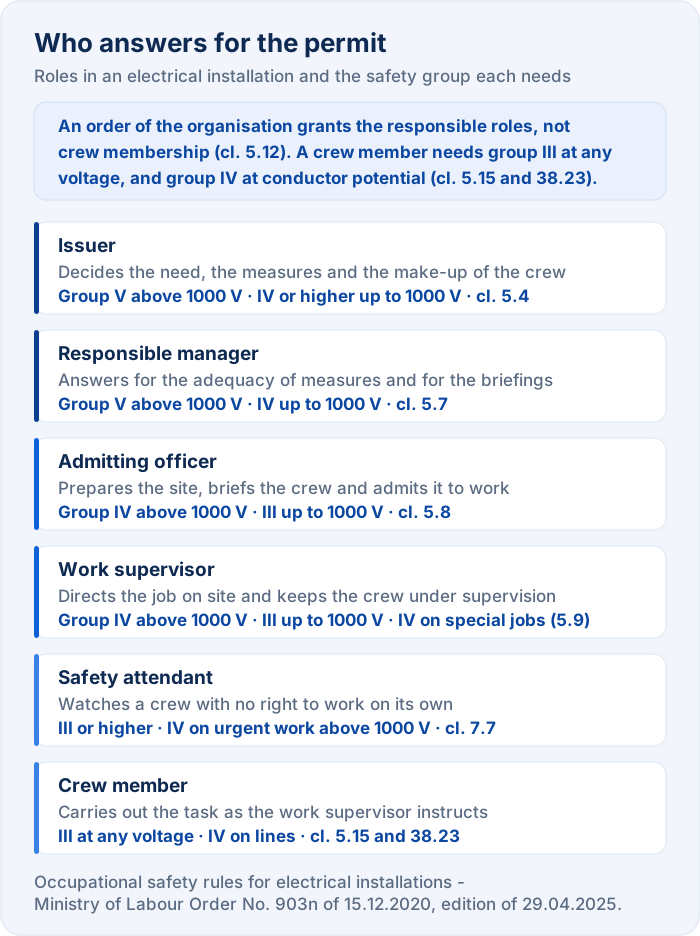
- the organisational and administrative document granting the rights of issuer, admitting officer, responsible manager, work supervisor and safety attendant (clause 5.12) - without it, nobody on site is lawfully appointed;
- the approved list of routine-operation tasks, signed by the person responsible for the electrical facilities and approved by the head of the organisation (clause 8.1).
4. Responsible persons and electrical safety groups
Clause 5.2 names the people who answer for the job, and the same division of duties runs through every Russian permit, as the guide on how a permit is issued shows. Who may sign, and on what authority, is covered in the guide on who issues a permit to work.
| Role | Appointed from | Safety group | Key duties | Clause |
|---|---|---|---|---|
| Issuer | Administrative and technical staff | V (>1000 V), IV or higher (≤1000 V) | Decides whether the job is necessary and can be done safely; appoints the responsible persons and the measures | 5.3, 5.4 |
| Responsible manager | Administrative and technical staff | V (>1000 V), IV (≤1000 V) | Answers for the adequacy of the preparation measures and for the quality of the briefings | 5.7 |
| Admitting officer | Operational staff | IV (>1000 V), III (≤1000 V) | Verifies site preparation, gives the targeted briefing, admits the crew | 5.8 |
| Work supervisor | Electrical staff | IV (>1000 V), III (≤1000 V); IV even at or below 1000 V in underground structures where noxious gases may appear, on live work, and when restringing conductors of a line at or below 1000 V carried on towers above 1000 V | Directs the work on site, keeps continuous control of the crew | 5.9 |
| Safety attendant | Electrical staff | III or higher; IV on urgent work above 1000 V (cl. 7.7) | Supervises crews that have no right to work in installations on their own | 5.10 |
| Crew member | Electrical / electrotechnological staff | III (see below); IV at conductor potential on overhead lines above 1000 V | Carries out the task under the supervisor's instructions | 5.11, 5.15, 38.23 |
How long each of these appointments stays valid is covered in the guide on permit validity. Clause 5.7 lets the issuer leave the responsible manager unappointed in installations with a simple, self-evident circuit, but it also lists the jobs where a responsible manager is always required - work with machinery and lifting appliances, work under induced voltage, work with two or more crews in one installation, and a dozen more.
Electrical safety groups I to V
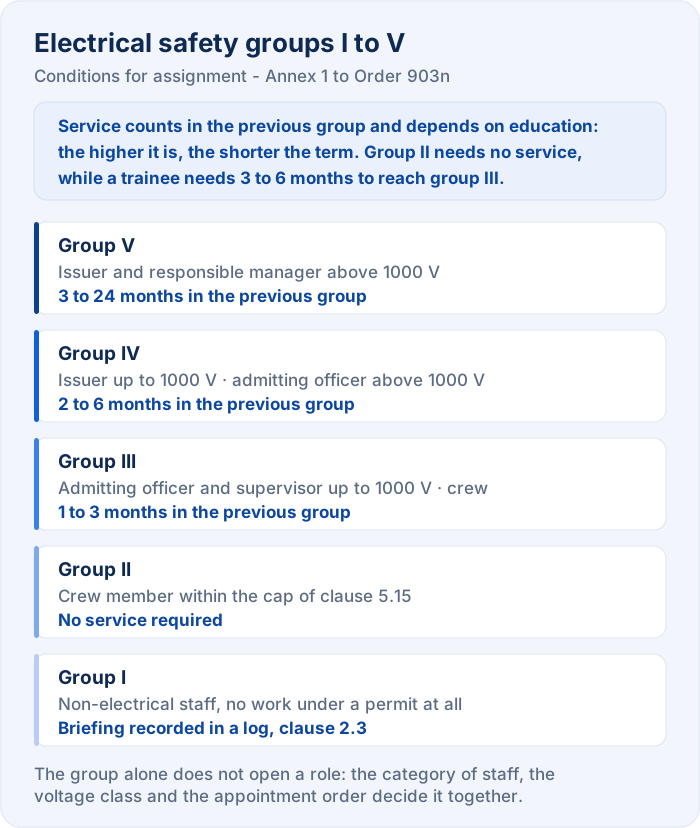
Staff are sorted into five electrical safety groups. The ladder is specific to Russia; the closest thing abroad is the British tier of authorised and competent persons, and the two do not map cleanly onto each other. Annex 1 to Order 903n sets what each group requires, and the minimum service in the previous group depends on the worker's education, which the annex spells out column by column.
| Group | Minimum service in the previous group | Role under a permit |
|---|---|---|
| I | Briefing, entered in a log, no certificate | Non-electrical staff; no work under a permit at all |
| II | Not required | Crew member, within the limit set by clause 5.15 |
| III | 1 to 3 months, by education | Admitting officer and work supervisor up to 1000 V; safety attendant; crew member |
| IV | 2 to 6 months | Issuer up to 1000 V; admitting officer above 1000 V; responsible manager up to 1000 V |
| V | 3 to 24 months | Issuer and responsible manager above 1000 V |
One rule about crew members is worth stating precisely, because it is often reported the wrong way round. A crew member working under a work supervisor must hold group III, whatever the voltage (clause 5.15). The clause states one exception itself: work at conductor potential on overhead lines above 1000 V calls for group IV (clause 38.23). Group II is not a lower-voltage equivalent: it is an allowance. One group II worker may be added for each crew member holding group III or above, and the crew may never carry more than three of them.
Group I is assigned to non-electrical staff by briefing, recorded in a log rather than in a certificate, by an electrical worker holding group III or an OSH specialist holding group IV or above (clause 2.3).
Combining duties
Clause 5.13 lets a responsible person take on one additional duty, and Table 2 to that clause sets out which. An issuer, for instance, may also act as responsible manager, work supervisor, or - in an installation with no local operational staff - admitting officer. An admitting officer drawn from operational staff may work as a crew member. Which combinations your organisation actually uses has to be fixed in the appointment order.
5. Completing the permit: step by step
The recommended form is Annex 7 to Order 903n, printed front and back.
| Section of the form | What goes in | Watch out for |
|---|---|---|
| Header | Organisation, unit, number, date | Numbering runs continuously, from the log |
| Responsible persons | Name and safety group of each | The group may be entered once (clause 6.23) |
| Crew | Name and safety group of each member | Two people minimum, the work supervisor included (cl. 4.1); some jobs set a higher floor, three in underground cable structures (cl. 37.35) |
| Place and scope | Dispatcher's names, voltage | Dispatcher's names only, not generic wording |
| Technical measures | Isolation, earthing, barriers, signs | Name the actual switching devices |
| Special instructions | Combined jobs, unusual conditions | State the grounds for a safety attendant |
| Dates | Start and finish, date and time | Up to 15 calendar days; one day for live work |
| Targeted briefing | Signatures of those briefed | No signature, no admission |
| Daily admission | An entry for each shift | Date, time, supervisor's signature |
| Closure | Finish date and time, signatures | Both copies are closed together |
The nine steps
- The issuer completes the front: scope, location, responsible persons, crew, and the preparation measures.
- The issuer gives the targeted briefing to the responsible manager and the work supervisor, and both sign.
- Two copies pass to the admitting officer and the supervisor, and the issue is logged in the register (Annex 8).
- The admitting officer, together with the supervisor, verifies the preparation: isolation done, earths applied, signs posted, barriers up.
- The admitting officer briefs the supervisor and the crew, and each of them signs.
- The supervisor briefs the crew at the workplace, with signatures on the back of the form.
- The admitting officer authorises the start, and the date and time are recorded.
- Each shift, the supervisor inspects the site and records the daily admission.
- On completion the permit is closed with the signatures of the supervisor and the admitting officer, and both copies go to storage.
Two practical points. Where one permit covers several workplaces on the same connection, the supervisor has to organise the crew so that every member stays under control (clause 6.7). And where the printed lines run out, an extra sheet may be attached under the same permit number (clause 6.24).
Four faults that come up in almost every inspection
- Vague wording such as "repair the equipment" instead of the dispatcher's own names. Write it the way the control room says it: "repair circuit breaker VV-10, bay 5, 10 kV switchgear, Zavodskaya substation".
- Safety steps that name no switching device. Write "open disconnector RL-10/400 in bay 5, prove dead, apply portable earth PZ-1", not "isolate the equipment".
- A briefing signed by some of the crew but not all. A worker who has not signed is not admitted.
- A live-work permit written for more than one day, which clause 6.3 forbids outright.
The whole sequence, step by step, is in the guide on how to issue a permit, and the question of which form fits which job is answered in the guide on Russian permit-to-work forms.
6. Admission, supervision, changes and breaks
At the first admission the admitting officer walks the site with the responsible manager and the supervisor to confirm that everything is prepared. The admitting officer then shows the crew what is still live, which measures are in place, and where the earths, signs and barriers sit. The admission is confirmed by signatures.
Supervision
After that the supervisor stays with the crew, and leaving members unattended is not allowed. Clause 6.13 gives one exception: where the crew is spread across several workplaces, one or more members holding group III may work apart from the supervisor - but only after the supervisor has walked them to their workplace in person and briefed them on the measures for that spot. Members may also leave the site temporarily, with the supervisor's permission and without being struck off the crew; above 1000 V at least two people must remain at the workplace, the work supervisor or the safety attendant among them (clause 11.3).
Changing the crew
Only the issuer, or another worker entitled to issue permits in that installation, may change the crew. The change is entered in the table on the back of the form. A work supervisor has no authority to swap people in or out.
That entry has a limit. Replace the responsible manager, the work supervisor or the safety attendant, change more than half the crew, or change the working conditions, and an entry is no longer enough: a new permit must be issued (clause 11.6).
Breaks
At the end of the shift the site is cleared, the crew is withdrawn, and the permit goes back to the admitting officer. The next day begins with a fresh inspection and a fresh admission by the admitting officer. Over a meal break everybody leaves the workplace and the permit stays with the supervisor, who readmits the crew afterwards without the admitting officer, provided nothing at the site has changed.
7. Overhead lines: specifics
Overhead lines have their own counting rule, and it is easy to get backwards: a separate permit is issued for each line, and on a multi-circuit line for each circuit (clause 6.18), not for each crew. One permit may cover several lines only in the cases the same clause lists. Work near a line's protection zone is written up against the clearances in Table 1 to the rules (clause 4.6).
On a de-energised line the crew may be spread over a section no longer than 2 km, and the issuer sets that length (clause 6.20). Under live conditions the whole crew stays on one tower, in one span, or on two adjacent towers.
When a thunderstorm approaches, work on overhead lines, overhead communication lines, outdoor switchgear and the connected cable sections must stop (clause 4.12). Where the lines of two owners cross, each company issues its own permit and the two control rooms agree the admission between them. Skipping that agreement is a common cause of incidents.
8. Validity, extension, cancellation and storage
Terms are set by clause 6.3 of Order 903n.
| Parameter | Value | Basis |
|---|---|---|
| Maximum term, de-energised work | 15 calendar days from the start date | clause 6.3 |
| Extension | Once, by up to 15 calendar days | clause 6.3 |
| Maximum in total | 30 calendar days (15 + 15) | clause 6.3 |
| Live work on conductive parts | 1 calendar day (one shift) | clause 6.3 |
| Extension of live work | Not allowed; a new permit is issued | clause 6.3 |
| Who may extend | The issuer, or another worker entitled to issue permits there | clause 6.4 |
| Storage after closure | 1 year | clause 6.5; art. 415 of the retention schedule, Order No. 236 |
| Storage if an accident occurred | 45 years, with the investigation file | clause 6.5; art. 415 of the same schedule |
The rules never use the word "cancellation", but they give two mechanisms. Where there is any doubt that the workplace has been prepared properly and sufficiently, the job waits for a new permit (clause 10.1). Where a breach of the rules, or any other circumstance threatening safety, comes to light during the work, the crew is removed from the site and the permit is taken from the work supervisor or the safety attendant; the crew returns only once the breach is fixed, under a newly issued permit (clause 11.4). The technical measures written into a live permit may not be altered. And a live-work permit cannot roll into a second day - that breach of clause 6.3 is one of the most common in this field. The full table of terms by work type is in the guide on how long a permit lasts.
9. Penalties and liability
Working with no permit, with a faulty one, or with untrained people all carry a price. Which part of Article 5.27.1 of the Code of Administrative Offences applies matters, because a general safety breach and letting an untrained worker on site are two different offences.
Amounts are in roubles, with a rough dollar figure at the Bank of Russia rate of 84.5 RUB/USD for 15 August 2026. Check the current rate on cbr.ru.
| Offence | Officer / sole trader | Legal entity |
|---|---|---|
| Art. 5.27.1(1) - breach of OSH requirements | Warning, or 2,000-5,000 RUB | Warning, or 50,000-80,000 RUB (~$590-950) |
| Art. 5.27.1(3) - admitting a worker without training or a medical check | 15,000-25,000 RUB | 110,000-130,000 RUB (~$1,300-1,540) |
| Art. 5.27.1(5) - repeat offence | Officer: 30,000-40,000 RUB or disqualification for 1-3 years. Sole trader: 30,000-40,000 RUB or suspension for up to 90 days | 100,000-200,000 RUB or suspension for up to 90 days |
| Art. 9.11 - breach of the rules for operating electrical installations | Individual: 1,000-2,000 RUB. Officer: 2,000-4,000 RUB. Sole trader: 2,000-4,000 RUB or suspension for up to 90 days | 20,000-40,000 RUB or suspension for up to 90 days |
Note the first line. Part 1 allows a warning instead of a fine, which is what a first, well-documented lapse often ends with.
Criminal liability under Article 143
Article 143 of the Criminal Code punishes a breach of occupational safety requirements by a person who was responsible for meeting them, where the breach negligently causes serious harm or death. The sentence is chosen from a range, and prison is only the top of it.
| Consequence | Sentence |
|---|---|
| Serious harm to health (part 1) | Fine up to 400,000 RUB or up to 18 months of earnings; or 180-240 hours of community service; or corrective labour up to 2 years; or forced labour up to 1 year; or up to 1 year in prison. The court may, but need not, add a ban on holding certain posts for up to 1 year |
| Death of one person (part 2) | Forced labour up to 4 years, or up to 4 years in prison. A ban on holding certain posts for up to 3 years is at the court's discretion |
| Death of two or more (part 3) | Forced labour up to 5 years, or up to 5 years in prison. A ban on holding certain posts for up to 3 years is at the court's discretion |
What each article costs is set out in the guide on penalties for working without a permit.
Electrical work sits on the sample list of high-risk work in Annex 2 to Order No. 776n, alongside gas-hazardous work and the rest. The exposure reaches the issuer, the responsible manager, the admitting officer, the work supervisor and the head of the company. Naming responsible people does not take the duty off the employer.
This page is a reference for foreign specialists working in Russia, not legal advice. The governing text is Ministry of Labour Order No. 903n in its current edition of 29.04.2025. Amounts, terms and clause numbers change - check the current wording on consultant.ru or pravo.gov.ru before you rely on them. Last verified: August 2026.
Frequently Asked Questions
How long is an electrical permit-to-work valid in Russia?
For de-energised work, up to 15 calendar days from the start date, extendable once by a further 15 days (30 days in total). For live work on conductive parts, one calendar day (one shift) with no extension - a new permit is issued for the next day (clause 6.3 of Order No. 903n).
Which electrical safety group is required to issue a permit?
In installations above 1000 V, group V; up to 1000 V, group IV or higher (clause 5.4 of Order No. 903n). The issuer is appointed from administrative and technical staff by an order of the head of the organisation.
How does an electrical permit differ from a work-at-height permit?
A different qualification ladder (electrical safety groups I-V instead of height safety groups 1-3), a dedicated admitting officer drawn from operational staff, a different legal basis (Order 903n instead of Order 782n) and a different form.
Can the permit be issued electronically?
Yes. Clause 6.6 of Order 903n allows the permit and the log to be completed electronically, through automated systems and with an electronic signature. The signing procedure itself is set by the employer's local regulations.
How long must a closed permit be kept?
One year after closure - clause 6.5 of Order 903n, and article 415 of the retention schedule approved by Rosarkhiv Order No. 236 of 20.12.2019. If an accident occurred, the permit is kept with the investigation file for 45 years.
How does Order 903n differ from PTEEP (Order No. 811)?
Ministry of Labour Order No. 903n sets occupational safety requirements: how to organise the work safely, permits, electrical safety groups. PTEEP (Ministry of Energy Order No. 811 of 12.08.2022) governs the technical operation of consumer electrical installations. For issuing a permit, the governing act is 903n.
Sources
- Order of the Ministry of Labour No. 903n (OSH rules for electrical installations)
- Article 143 of the Criminal Code of the Russian Federation (violation of OSH requirements)
- Article 5.27.1 of the Code of Administrative Offences (violation of OSH requirements)
- Article 9.11 of the Code of Administrative Offences (breach of electrical installation rules)
- Article 214 of the Labour Code of the Russian Federation (employer duties in occupational safety)
- Government Decree No. 2464 of 24.12.2021 (OSH training and briefings)

Smart Permit electronic system: ready-made templates for all types of work, electronic signature, automatic log, deadline reminders. Save up to 70% of permit processing time. A single document in Excel takes 40 minutes. In Smart Permit: 3 minutes.