
Contents
1. What is a permit-to-work2. When is a permit-to-work required3. Types of permits: full classification4. Who issues the permit-to-work5. Permit issuance procedure6. Permit validity period7. Work without a permit-to-work8. Liability and fines9. Permit-to-work by industry10. Frequently asked questionsIn Russia the fine for working without a permit-to-work is RUB 50,000-80,000 for an organisation under the general case (Part 1, Art. 5.27.1 of the Code of Administrative Offences), rising to RUB 110,000-130,000 if the crew was also admitted without training or a medical exam (Part 3). Repeat violation: up to RUB 200,000 or suspension of operations for 90 days (Part 5, Art. 5.27.1). Meanwhile, Order No. 776n of the Ministry of Labour describes 24 categories of hazardous tasks, each with its own rules, forms, and deadlines. Which permit to issue for a welder on a roof? For an electrician in a 10 kV switchgear room? What if both hot work and gas-hazardous activities are on site at the same time?
1. What is a permit-to-work
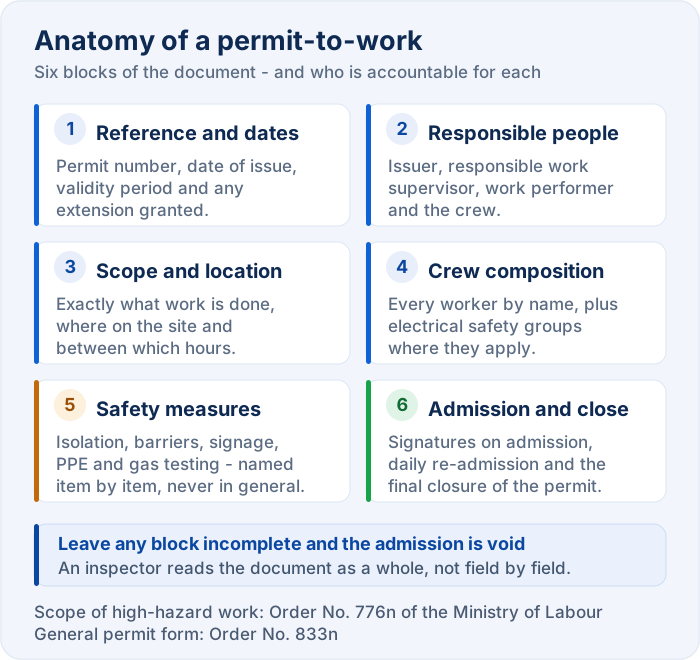
A permit-to-work (PTW) is a formal written authorisation for high-hazard activities under Russian occupational-safety law. The document specifies the scope, location, time and conditions of the work, the required safety measures, the composition of the crew, and the persons responsible for safe execution.
Starting hazardous activities without this document is prohibited. This is a direct requirement of the occupational-safety rules. The list of high-hazard work is set out in Annex No. 2 to Order No. 776n of the Ministry of Labour (29.10.2021); the forms and the procedure come from the industry rules for each type of work. The fine for working without an issued permit is RUB 50,000-80,000 for a legal entity under the general case (Part 1, Art. 5.27.1 of the Code of Administrative Offences), and RUB 110,000-130,000 if the crew was also admitted without training, knowledge testing or a medical exam (Part 3). A repeat violation can cost an HSE engineer disqualification for one to three years (Part 5, Art. 5.27.1 of the Code of Administrative Offences).
Inspection experience at Russia's State Labour Inspectorate (GIT) shows that a significant proportion of permits contain errors. Common issues: work supervisor not identified, safety measures omitted, admitting officer's signature missing. Each error is grounds for an order and a fine.
The indicative list of high-hazard work is established in Annex 2 to Order No. 776n of the Ministry of Labour (29.10.2021) on the Model Regulation for Occupational Safety Management (OSMS). This list is not exhaustive. Each organisation approves its own list, reflecting how it actually operates: clause 55 of the Training Rules (Government Decree No. 2464) speaks of high-hazard work «defined by the employer’s local regulations». Cutting the list below the indicative one without justification is not allowed.
Why does any of this matter? Not to generate paperwork. The PTW system forces you to think through risks in advance, rather than after an accident. It is the only document that links a specific person with specific safety measures at a specific workplace. No other document in Russian legislation serves this purpose.
At large enterprises (oil refineries, metallurgical plants) between 20 and 50 permits are issued per shift. At construction sites with multiple contractors the number can reach 100 per week. Each of these documents passes through the hands of several responsible persons, and an error at any stage leads to a fine or, worse, an injury.
2. When is a permit-to-work required
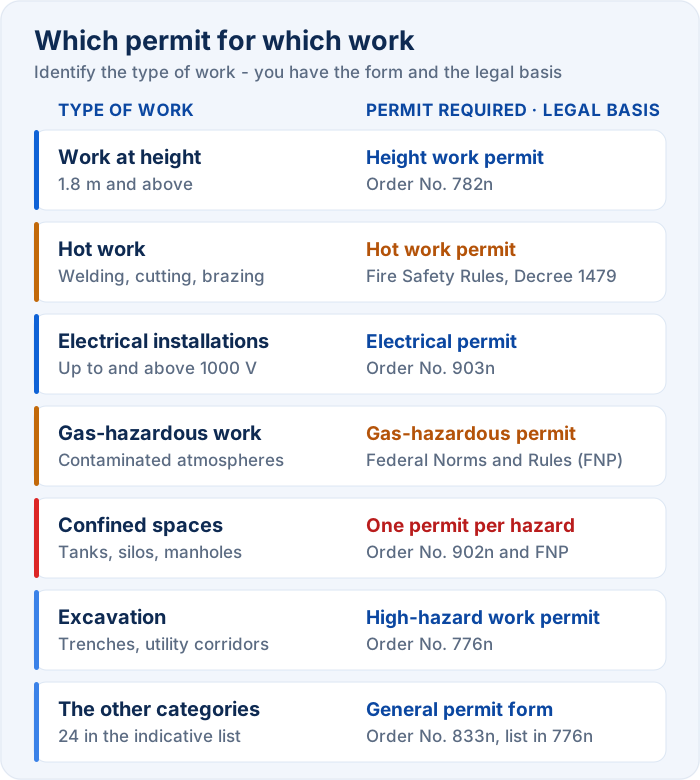
There is no single exhaustive list in the legislation. Order No. 776n contains an indicative list of 76 entries (Annex 2); many of them describe the same work from different angles, so our guide groups them into 24 categories. Organisations approve their own lists, but narrowing the list below that baseline is a violation.
| Type of work | Examples | Regulatory basis |
|---|---|---|
| Working at height | Above 1.8 m without barriers, high-altitude work (from 5 m), roofs, masts | Order No. 782n |
| Hot work | Welding, cutting, brazing, heating. Temporary hot work in explosion-hazardous zones | Fire Safety Rules (Gov. Decree 1479) |
| Electrical installations | Up to and above 1000 V, on overhead lines, cable lines and switchgear. Electrical safety qualification (admission) groups II-V | Order No. 903n; POTEU — Occupational Safety Rules for Operating Electrical Installations (Gov. Decree 875) |
| Gas-hazardous | Work in atmospheres with harmful gases and vapours. Tanks, manholes, tunnels | Federal Norms and Rules (FNP) |
| Excavation | Near underground utilities, trenches over 1.5 m deep | Order No. 776n |
| Confined spaces | Tanks, cisterns, bunkers, silos, boiler fireboxes, manifolds | Order No. 902n and the FNP |
| Installation and dismantling | Equipment, buildings, lifting machinery | Order No. 776n |
| Lifting operations | Cranes, lifts, hoists, conveyors, rigging | Federal Rules for Lifting Structures |
| Blasting | Drill-and-blast, seismic exploration, disposal of explosives | Federal Norms and Rules (FNP) |
How to determine if authorisation is required? A simple algorithm: open your organisation's list (it must be approved by order of the head). If the work is on the list, issue a permit. No list? That is already a violation, and any hazardous work is formally being performed unlawfully.
The full list includes 15 more categories: tasks near power lines, in restricted zones, at operating facilities, with hazardous chemicals, and others. Each category is covered on a dedicated guide page.
3. Types of permits: full classification
Authorisations for different types of hazardous activities differ. Each type is linked to its own regulatory framework, and form templates also vary.
| Type | Scope of application | Regulatory basis |
|---|---|---|
| General high-hazard work permit | All types of work under Order No. 776n | Order No. 833n (form), No. 776n |
| Electrical installations permit | Up to and above 1000 V, all operations in electrical installations | Order No. 903n; POTEU (Gov. Decree 875) |
| Working at height permit | Above 1.8 m without barriers, high-altitude from 5 m | Order No. 782n |
| Hot work permit | Welding, cutting, brazing in fire-hazardous zones | Fire Safety Rules (Gov. Decree 1479) |
| Gas-hazardous work permit | In gas-contaminated atmospheres, on gas pipelines | Federal Norms and Rules (FNP) |
| Confined space permit | Tanks, vessels, manholes | Order No. 902n and the FNP |
| Excavation permit | Trenches, protected zones of underground utilities | Order No. 776n |
Can you get by with one document when different types of hazards overlap? A common question on sites. For example, a welder works at a height of 6 metres inside a vessel. Three categories intersect here: hot work, working at height, confined spaces. In this situation, as a rule, several permits are needed simultaneously.
In the oil and gas industry, up to 6 permits can be active simultaneously at a single site. That is standard practice, not an exception.
4. Who issues the permit-to-work
Persons authorised to issue permits are appointed by order of the organisation's head. Without this order, issuance is unlawful. There are four roles in the PTW system. Each has its own authority and area of responsibility.
- Issuer. Head of structural unit or chief engineer. Determines: whether the work can be organised safely, what measures are needed, who will be in the crew. The issuer's signature is the work authorisation. If the issuer missed a hazard factor and an accident occurred, they are liable up to criminal responsibility under Art. 143, 216, 217 of the Criminal Code.
- Responsible manager. Oversees the implementation of safety measures on site. Checks: barriers are installed and PPE is issued. They also deliver the targeted briefing to the crew, who sign for it in the permit (clause 56(g) of Order No. 782n). If measures are specified in the permit but not implemented on site, that falls to them.
- Work supervisor. Leads the crew on site and makes sure PPE is used and the safety measures are followed. They may not leave the site while the crew is working. In electrical installations the admitting officer is a separate role, not another name for the work supervisor: they are drawn from the operational staff, they prepare the workplace and admit the crew to it, and they hold an electrical safety group of at least III (up to 1000 V) or IV (above 1000 V).
- Crew members. Have undergone HSE training, received a targeted briefing, and signed the permit. In electrical installations the crew is a group of two people or more, the work supervisor included (clause 4.1 of Order No. 903n). The height rules set no headcount of their own: the size follows the risk assessment.
Who can combine roles? It depends on the regulations. For electrical installations this is set by Table 2 to clause 5.13 of Order No. 903n: the issuer may also take on the duties of the responsible manager or of the work supervisor, and in installations without local operational staff those of the admitting officer as well. Only one additional duty is allowed — two at once are not. The work supervisor does not always take on the admitting officer's duties: for that they must come from the operational or operational-repair staff, and the layout of the installation must be simple and easy to read. For work at height (Order No. 782n) there is no rule on combining at all, and the issuer and the work supervisor cannot be the same person there because of how the roles are staffed: one is drawn from the specialists, the other from the workers.
Read the full guide to who issues a permit-to-work in Russia and what each role is accountable for
5. Permit issuance procedure
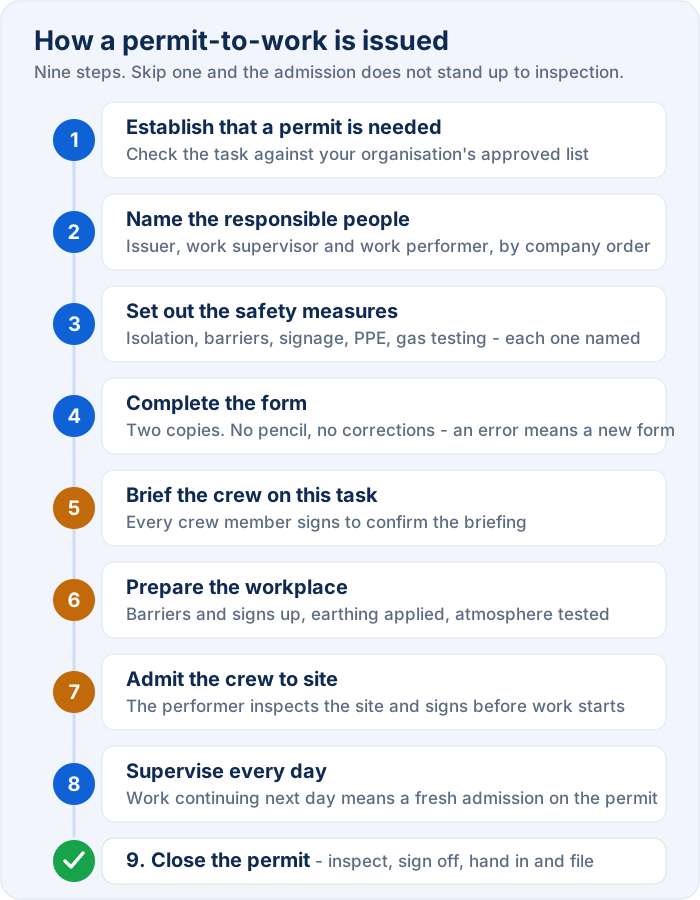
Issuing a permit is not just filling out a form. It is a 9-step process, each step documented in the regulations.
- Determine the need. Cross-reference the task with the organisation's list.
- Assign responsible persons. Issuer, responsible manager, work supervisor - by organisational order.
- Develop safety measures. Specific measures: barriers, signs, lockouts, PPE, air testing (for gas-hazardous and confined spaces), equipment isolation.
- Fill out the form. Two copies. Pencil is prohibited. Corrections are not allowed - only a new form.
- Conduct a targeted safety briefing. Each crew member signs. The briefing is given by the responsible manager (clause 56(g) of Order No. 782n). In electrical installations it runs as a chain: the issuer and the admitting officer before admission, the responsible manager or the work supervisor before work starts (clause 6.32 of Order No. 903n).
- Prepare the workplace. Install barriers, post safety signs, check protective equipment, earthing (for electrical installations), gas levels (for gas-hazardous work).
- Admit the crew. The work supervisor inspects the site and signs off. Only then does the crew start work.
- Daily oversight. If the work continues the next day, admit the crew again and record it in the permit.
- Close the permit. Inspect the workplace, collect signatures, return to the issuer. Retention: 30 days for height permits (clause 66 of Order No. 782n), 1 year for electrical installations (clause 6.5 of Order No. 903n) and confined spaces (clause 71 of Order No. 902n), at least 6 months for gas-hazardous and hot work (FNR No. 528). Order No. 833n sets no retention period for the general permit.
An error made at every third site: filling out the form after work has started, "backdating" it. During a GIT inspection this is easily detected (briefing time is later than the work start time). A fine is inevitable.
Another common problem: safety measures are recorded in generic terms. "Ensure safety" or "use PPE", instead of specifics: "put on a safety harness with two lanyards, attach the carabiner to a support at 1.5 m height". Vague wording protects neither the worker nor the HSE engineer.
A third typical mistake: the crew signs the permit but cannot recount the content of the targeted briefing. A GIT inspector has the right to interview crew members right on site. If a worker does not know what hazard factors are listed in their permit, the briefing is considered not conducted.
How to check yourself before admission? Five control questions: (1) is a specific work supervisor named? (2) are all hazard factors in the work zone listed? (3) are specific PPE items recorded with types and sizes? (4) have all crew members signed? (5) does the briefing time match the start time? If even one answer is "no" - the permit is not ready.
See the step-by-step issuance guide, with a completed sample form
6. Permit validity period
Validity periods depend on the type of hazard. This is a direct regulatory requirement, not a recommendation. Violating a validity period is treated the same as working without a permit: a fine under Art. 5.27.1 of the Code of Administrative Offences.
| Type of permit | Validity period | Extension |
|---|---|---|
| General high-hazard work permit | For the duration of the work, no more than 15 calendar days | Yes, once, for another 15 days |
| Electrical installations permit | 15 calendar days from the start | Yes, once, for 15 calendar days |
| Working at height permit | 15 calendar days from the start | Yes, once, for 15 calendar days |
| Hot work permit | One working shift | No. New shift - new permit |
| Gas-hazardous work permit | One working shift (daytime) | No |
Note: work at height, de-energised electrical installations and confined-space work are counted in calendar days (up to 15). But energised electrical work is strictly 1 calendar day, and hot/gas-hazardous work is one shift. Confusion here is costly.
Hot work and gas-hazardous permits are the strictest of all. One permit per shift, no extension. At oil refineries, a welder may receive a new permit every 8 hours. That is standard practice rather than excessive paperwork: site conditions change quickly, and the atmosphere has to be retested.
Who extends a permit? The person who issued it. Or a person with equivalent authority under the organisational order. Extension is recorded with the date and signature.
See the full table of validity periods, work type by work type
7. Work without a permit-to-work
Not everything requires full documentation. Some tasks are not high-hazard work at all; others are covered by the approved list of routine operation work. In the power sector there is a third form - a written order, which is a task-specific instruction entered in a register rather than issued on a permit form (clause 7.1 of Order No. 903n). It applies where the risk has been removed in advance or the work is urgent, not where the task merely looks simple.
- Working at height from inventory scaffolding with protective barriers (handrails, toe boards). Where the scaffolding is serviceable and has been signed off as fit for use, no permit is required.
- Routine operation of electrical installations: maintenance carried out as part of running the equipment day to day. The list of such tasks is approved by the unit head.
- Minor routine repairs that need no shutdown, no opening of the equipment and no work near moving parts.
At one facility in 2024, an electrician suffered a severe electrical injury during "maintenance as part of day-to-day operations". The investigation showed: the work had been incorrectly included in the routine operations list; in fact, it required equipment isolation and a permit-to-work. The occupational-safety engineer received a custodial sentence — not a suspended one — under Art. 143 of the Criminal Code.
The rule is simple. Not sure if full documentation is needed? Issue it. A permit issued needlessly costs RUB 0. A permit missing during an inspection costs an organisation from RUB 50,000 under Part 1, and where further offences are found (no training, no PPE issued) the fines add up and the total passes RUB 280,000. The arithmetic settles the question.
Another common question: what to do with urgent tasks when there is no time for full documentation? If the situation is not an emergency, there is always time. 15–20 minutes to fill out the form and conduct the briefing. If it is a genuine emergency, industry-specific rules (e.g. clause 52 of Order No. 902n, clause 49 of Order No. 782n) allow starting without a permit, but after the emergency is contained, the permit must be issued.
Anything left off the approved list still needs a permit, however routine it looks.
8. Liability and fines
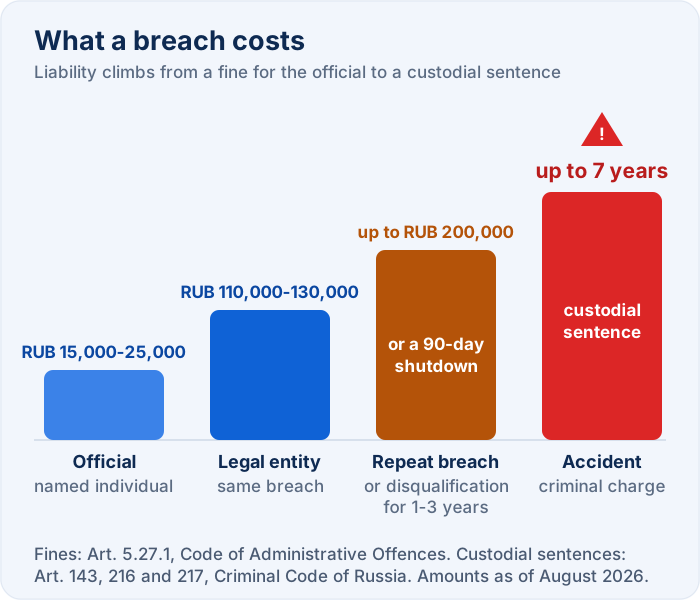
Administrative and criminal liability is provided for violations. Fine amounts are current as of August 2026.
| Violation | Fine for officials | Fine for legal entities |
|---|---|---|
| Breach of occupational-safety requirements, general case (Part 1) - this covers working without a permit and failure to supervise | warning or RUB 2,000 - 5,000 | warning or RUB 50,000 - 80,000 |
| Admitting a worker without training, knowledge testing, a medical exam or a psychiatric assessment (Part 3) | RUB 15,000 - 25,000 | RUB 110,000 - 130,000 |
| Failure to provide personal protective equipment (Part 4) | RUB 20,000 - 30,000 | RUB 130,000 - 150,000 |
| The same offences by a person already penalised for an analogous one (Part 5) | RUB 30,000 - 40,000 or disqualification for 1-3 years | RUB 100,000 - 200,000 or suspension up to 90 days |
| Accident resulting from violations | Criminal liability under Art. 143, 216, 217 of the Criminal Code | - |
Basis: Art. 5.27.1 of the Code of Administrative Offences, Art. 143, 216, 217 of the Criminal Code of Russia. The inspector picks the part from the substance of the violation: a missing permit on its own is Part 1, while Part 3 is added when people were admitted without training or a medical exam. In practice the labour inspectorate often finds several offences at once and the fines add up - per violation and, in Rostrud's position, per worker under each count (case law on the second point is not settled).
Typical violations identified during GIT inspections: working without a permit, incorrectly filled forms, expired permits, absence of a targeted briefing. The most common by frequency: admitting a crew without an issued permit.
Criminal liability arises not from the fact of a violation, but from its consequences. Serious harm to a worker's health: Art. 143 Part 1 of the Criminal Code, up to one year of imprisonment. Death of one person: Part 2 Art. 143 (up to 4 years), Art. 216 Part 2, Art. 217 Part 2 (up to 5 years). Death of two or more: Part 3 Art. 143 (up to 5 years), Art. 216 Part 3, Art. 217 Part 3 (up to 7 years).
A separate category of violations: "checkbox" permits. Formally filled out, signatures are in place, but safety measures were not implemented. Barriers not installed, PPE not issued, gas levels not measured. During an accident investigation, this is treated more severely than a missing permit. Courts treat this as an intentional violation.
9. Permit-to-work by industry
The permit-to-work system operates in all industries where high-hazard work is performed. Intensity depends on the specifics.
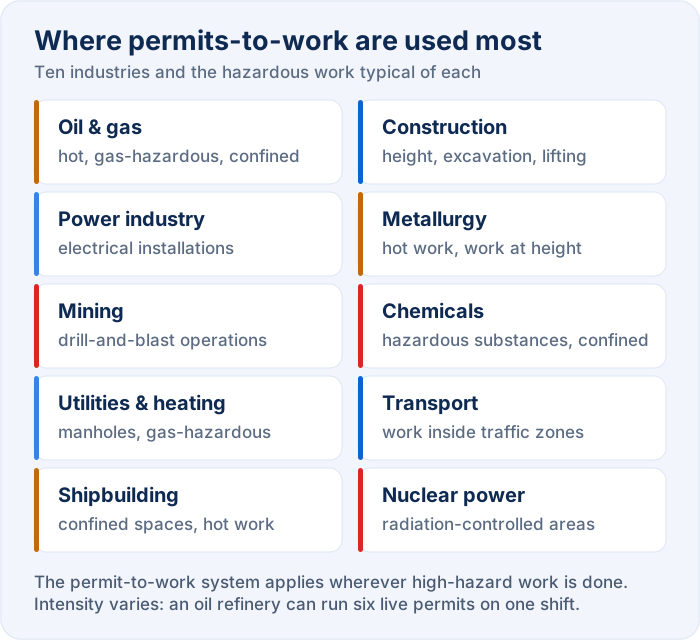
Oil & Gas. Hot work, gas-hazardous work, work at height and confined-space entry, all running at once. Up to 6 permits per shift at a well pad. The widest range of types. Regulated by the Federal Norms and Rules for hazardous production facilities, and additionally by corporate standards (Gazprom, Rosneft, LUKOIL have their own systems, sometimes stricter than federal ones).
Construction. Up to 70% of construction tasks require a permit. Height, excavation, installation and crane work make up the standard set. Specifics: multiple contractors on one site, and permit coordination between them is a separate challenge. Who coordinates? The general contractor, under Art. 214 of the Labour Code.
Power Industry. A separate PTW system under Order No. 903n of the Ministry of Labour (occupational-safety rules for operating electrical installations; technical operation is additionally governed by POTEU - Gov. Decree 875). Its own forms, its own procedure, its own admission groups (II–V). The permit for electrical installations is not the general form (Order No. 833n), but a specialised form under Order No. 903n.
Metallurgy. Operations near molten metal, in hot shops, equipment repairs. Hot work and working at height are the main types. The temperature factor adds PPE requirements and work regime rules (shortened shifts, mandatory breaks).
Mining. Mines, quarries, drill-and-blast operations. The strictest requirements. Regulated by Federal Rules for mining. The work order (in mines) is a separate form. Do not confuse them.
Chemical Industry. Operations with hazardous chemical substances, in confined spaces, gas-hazardous work. Enhanced requirements for decontamination, air testing, emergency PPE reserves. Response time in case of a leak - minutes.
Utilities & Heating. Manholes, heating mains, electrical installations in residential buildings. Gas-hazardous work in basements is a frequent task. Specifics: sites are dispersed across the city, oversight is more difficult.
Transport. Railway tracks, roads, ports, airports. Work inside traffic zones adds a hazard of its own. Specific measures in the permit: signal fencing, posting lookouts.
Shipbuilding & Repair. Confined spaces (compartments, tanks), hot work, working at height in dry docks. Plus diving operations with their own permits.
Nuclear Power. The strictest system. Operations in ionising radiation zones, mandatory dosimetric control, admission through the radiation safety service. A violation here is not a fine, but criminal liability. Separate requirements for crew composition, function duplication, and emergency planning.
How to choose the right set? Identify your industry, identify the types of hazards at the site, check industry-specific Federal Rules and regulations. For an oil & gas enterprise, the standard set: general (Order No. 833n) plus hot work (Fire Rules) plus gas-hazardous (Federal Rules). For a construction site: general plus working at height (Order No. 782n). For an electrical grid company: a specialised permit under Order No. 903n, which replaces the general one.
In practice, errors most often arise at industry intersections. A contractor from a construction company arrives at a petrochemical plant. They are accustomed to the general form (Order No. 833n), but the plant operates under the Federal Norms and Rules for hazardous production facilities. Forms differ, the admission procedure is different, briefing requirements are stricter. If the contractor issues "their own" permit by "their own" rules rather than the client's rules - the permit is invalid.
The intensity differs by industry; the rule does not. Identify the hazard, then issue the permit the rules attach to it.

10. Frequently asked questions
At what height is a permit-to-work required?
Full documentation is mandatory for work at heights above 1.8 m without protective barriers, as well as for all high-altitude work (from 5 m). If you are working from inventory scaffolding fitted with barriers, a permit is generally not required: clause 8 of Order No. 782n allows such work without a permit under the employer's own OSH management system. The height rules do not recognise a written order as a valid form of authorisation.
How many permits can be issued simultaneously?
The legislation does not set a hard limit. In practice, there is one constraint: the issuer must ensure oversight of every issued permit. If 10 permits are issued but there is no one to oversee them - that is a violation.
What is the difference between a permit-to-work and a written order?
Both documents are written; the difference is the term and the way it is recorded. A permit-to-work uses the prescribed form and is valid for up to 15 calendar days. A written order is also a written assignment (clause 7.1 of Order No. 903n), but it is entered in a logbook and lasts a working day or a shift. Which form applies is dictated by the rules for the type of work, not by how simple the task looks.
Is a permit required for emergency response?
During emergency response, work may begin without a permit. But after the emergency is contained, a permit is issued (e.g. clause 52 of Order No. 902n, clause 49 of Order No. 782n). The remediation work then follows the standard procedure.
Where are closed permits stored?
Closed permits are stored with the person who issued them or in the unit archive. Retention period depends on the type: 30 days for height permits, 1 year for electrical installations and confined-space work, at least 6 months for hot and gas-hazardous work at hazardous production facilities. In case of an accident, the permit is retained in the investigation materials for 45 years.
Who extends a permit-to-work?
The person who issued the permit can extend it, or a person with equivalent authority under the organisational order. Extension is recorded in the permit with the new date and signature. Not all types allow extension: hot work and gas-hazardous permits are reissued for each shift.
How long is a permit retained?
Minimum retention periods depend on the type: 30 days for height permits (clause 66 of Order No. 782n), 1 year for confined-space work (clause 71 of Order No. 902n) and electrical installations (clause 6.5 of Order No. 903n), at least 6 months for hot and gas-hazardous work at hazardous production facilities (clauses 64 and 105 of Federal Rules No. 528). If an accident occurred during the work, the permit is attached to the investigation materials and retained for 45 years.