Smart Permit electronic system: ready-made templates for all types of work, electronic signature, automatic log, deadline reminders. Save up to 70% of permit processing time. A single document in Excel takes 40 minutes. In Smart Permit: 3 minutes.
A permit to work in Russia, called a naryad-dopusk, is a written order that authorises high-risk work and records the task, the crew, the hazards and the safety measures before anyone starts. Russian law does not define it in one place. About a dozen ministerial orders each prescribe a permit for their own hazard, from work at height starting at 1.8 m, or 5.9 ft, to work inside a vessel. This guide covers what the document does, who signs it, how long it lasts, and when Russian rules let a crew work without one.
The audience here is the engineer who already runs a permit system somewhere else and now has a Russian site to cover. Most of the concepts will look familiar. The way they are packaged will not.
What is a permit to work in Russia?
A Russian permit to work is a written order that transfers a specific job, at a specific place, to a named crew under named supervision, for a stated period. Where a checklist records what was done and a risk assessment records what might happen, this document records who answered for what, which is why an investigator asks for it first after an accident.
The permit records five things:
- what the job involves, where it is done and under what conditions;
- the crew, by name;
- the hazards present at that workplace;
- the safety measures, stated as actions rather than slogans;
- the officers responsible, with their signatures.
The transliteration matters when you talk to a Russian safety officer. Naryad-dopusk is the permit itself. A rasporyazhenie covers lower-risk jobs and carries no permit formalities. Despite the way it is usually translated, it is not a verbal order: clause 7.1 of Order No. 903n defines it as a written task, and only allows it to be passed on by telephone or radio if both sides log it and sign. Mixing the two in a conversation with an inspector will cost you credibility fast.
One point catches almost every newcomer. The Russian permit is not primarily a hazard-control tool. It is an accountability tool. Safety measures live in it, yes, but its legal weight comes from the signatures: this person judged the workplace ready, that person led the crew, this third person authorised the whole thing. Strip the signatures and the paper is worthless.
Which Russian law makes a permit to work mandatory?
No single law does. Article 214 of the Labour Code puts the general duty on the employer to provide safe working conditions, and the detailed permit requirements sit in industry safety rules issued by the Ministry of Labour. Each order covers one family of hazards and prescribes its own permit form.
| Order or act | What it covers | Permit form |
|---|---|---|
| Order No. 782n of 16.11.2020 | Work at height from 1.8 m, or 5.9 ft | Recommended form, Annex No. 2 |
| Order No. 903n of 15.12.2020 | Operation of electrical installations | Recommended form, Annex No. 7 |
| Order No. 902n of 15.12.2020 | Confined and restricted spaces | Not prescribed. Clause 47 requires the employer to approve its own form |
| Order No. 883n of 11.12.2020 | Construction, reconstruction, repair | Recommended form, Annex No. 2, plus a site admission act as Annex No. 1 |
| Order No. 833n of 27.11.2020 | Placing, installing, servicing and repairing equipment | Recommended form, Annex No. 1 - the general-purpose permit |
| Order No. 776n of 29.10.2021 | Model safety management system | None. Supplies the model list of high-risk work |
| Decree No. 2464 of 24.12.2021 | Occupational safety training | None. Sets who must be trained and how |
All seven are linked to their official Russian texts, on Consultant.ru or on the state publication portal pravo.gov.ru. Editions differ, and the difference matters if you are quoting them. Orders No. 782n, No. 903n, No. 902n and No. 883n stand in their edition of 29 April 2025. For Order No. 833n we could not confirm the edition against the official card, so treat its date as unverified and check before quoting. Order No. 776n has never been amended. Decree No. 2464 was amended on 30 June 2026, and that edition took effect on 31 August 2026.
Order No. 833n is the one to know if your hazard has no order of its own. It covers the placing, installation, servicing and repair of equipment, and clause 31 annexes a recommended permit form for high-risk work in general. Russian employers reach for that form when the job does not fall under height, electrical or confined-space rules. The full set of prescribed and recommended forms, and which one belongs to which hazard, is laid out in the guide to permit-to-work forms.
The list that Order No. 776n supplies
Order No. 776n deserves a note of its own. It never uses the word naryad-dopusk. What it gives you is Annex No. 2, a model list of high-risk jobs, and the employer builds its own list from there under clause 55 of the training procedure in Decree No. 2464. So the question "does Russian law require a permit for this job" has no universal answer. It requires one if your employer's own list says so. Your employer writes that list, though not from a blank page: under clause 55 it is built on the list the Ministry of Labour sets.
A second regulator on hazardous production facilities
For hazardous production facilities a second regulator appears. Rostekhnadzor issues federal norms and rules that govern gas-hazardous and hot work on those sites, FNP No. 528 above all, with their own permit forms and their own inspectors. A refinery therefore lives under two permit regimes at once, labour safety and industrial safety, and both sets of paper have to exist.
Why does Russia have no single permit-to-work standard?
Because the Russian system grew hazard by hazard, while the British and American systems grew company by company. That difference explains most of the friction an expatriate engineer feels in the first month.
| Russia | United Kingdom | United States | |
|---|---|---|---|
| Source of the rule | Ministerial orders per hazard | HSE guidance, HSG250 | OSHA standards for specific hazards |
| Permit form | Recommended sample in the order, or the employer’s own | Written by the company | Written by the company, content specified for confined space and hot work |
| Legal status of the form | The content binds, the layout does not | Guidance, though enforceable through general duties | Binding content, free format |
| Who decides the scope | Employer, from a model list | Employer, from risk assessment | Standard plus employer judgement |
| Language of record | Russian | English | English |
In the United Kingdom, HSE guidance HSG250 tells you what a good permit system looks like and leaves the form to you. OSHA in the United States regulates the hazards rather than the paperwork: 29 CFR 1910.146 for permit-required confined spaces, 29 CFR 1910.252 for hot work, with no general permit-to-work rule at all. Russia went the other way: the regulator wrote the form and annexed it to the order. The wording is softer than it looks, though. Most of the orders call their annex a recommended model, so an employer may shape the form to its own process as long as every required field survives. What an inspector checks is whether your form carries what the order asks for, not whether it is a photocopy of the annex.
The practical consequence is blunt. Your corporate permit template, however good, does not satisfy a Russian inspector on its own, because it was built around different required fields. Contractors have argued this point on oil and gas sites for hours, holding a permit system certified against a global standard, and lost. The inspector was not judging the safety of the system. He was checking whether the form matched the order.
Who signs a Russian permit to work?
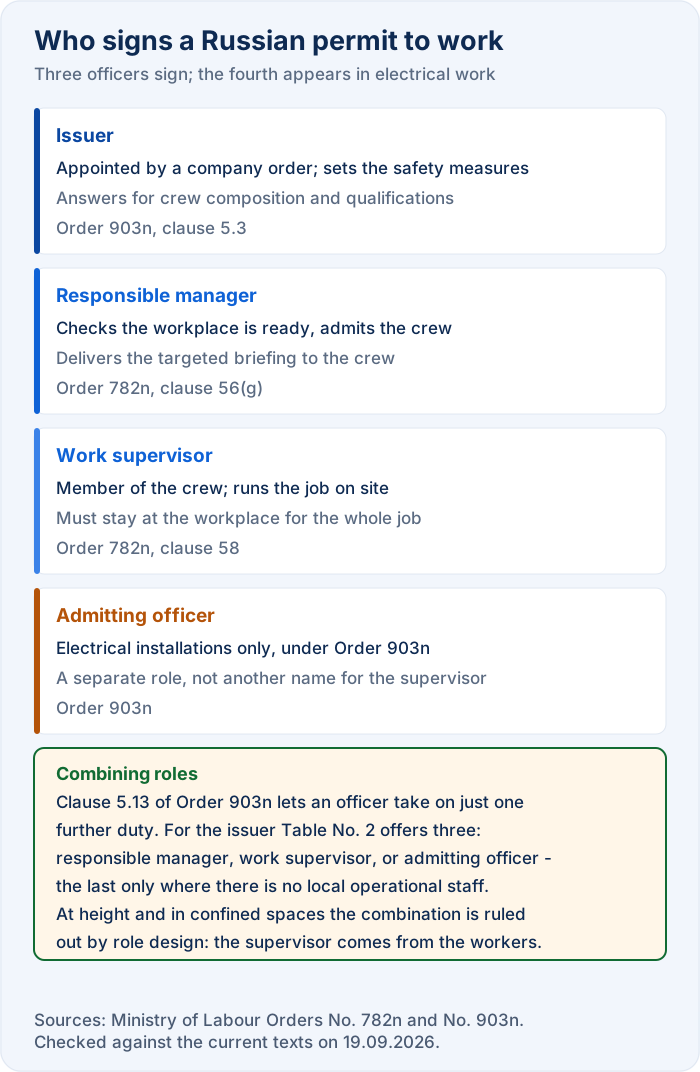
Three officers sign, and each carries personal liability for a different slice of the job. A fourth role appears in electrical installations only. Who may hold each of them, and what paperwork stands behind the appointment, is set out in the guide to who issues a permit to work.
The issuer. A manager or specialist authorised by a company order. The issuer decides the safety measures and answers for the crew itself: its size, its make-up, and whether each member is qualified for this particular job. In an electrical permit that includes the electrical safety group of every worker named on the form. Clause 5.3 of Order No. 903n puts all of it on the issuer, which surprises engineers who expect the site manager to vet the crew. The check happens before the paper leaves the office. Without a valid appointment order behind the signature, the permit is a note, not a permit, and inspectors ask for that order as a matter of routine.
The responsible manager. Confirms that the preparation measures are complete and sufficient, adds whatever further measures the conditions call for, and decides whether the workplace is genuinely ready. This officer also gives the crew its targeted briefing: clause 56(g) of Order No. 782n puts that duty here rather than on the supervisor, and the rules for confined spaces read the same way. Electrical work runs the briefing as a chain instead. Under clause 6.32 of Order No. 903n the issuer, the admitting officer and then the responsible manager each brief their part, covering everyone from the issuer down to the last crew member, while clause 5.7 holds the manager answerable for how complete the crew's briefing was. In practice this is the foreman or site superintendent, and this is the person who decides whether the crew steps on site.
The work supervisor. Runs the job at the workplace and checks that the safety measures hold. Under clause 58 of Order No. 782n this officer belongs to the crew itself, and must stay at the workplace for the whole job. Leaving without handing the permit to a qualified replacement stops the work and sends the crew out.
The admitting officer. Exists in electrical installations under Order No. 903n, where it is a separate role, not another name for the supervisor. Confusing these two is one of the more common errors in translated procedures. Details sit in the guide to permits in electrical installations.
Can one person hold two of these roles?
Combining roles is possible, but the rules disagree with each other. Clause 5.13 of Order No. 903n lets a responsible officer take on exactly one further duty, never two, and Table No. 2 lists which. For the issuer the choice is responsible manager, work supervisor, or admitting officer, and the last of the three only in installations with no operational staff of their own. The table has four more rows. The officer who authorises workplace preparation and admission may act as issuer, responsible manager or admitting officer. The responsible manager may take on the work supervisor’s duties, or the admitting officer’s where there is no local operational staff. A work supervisor drawn from operational or operational-repair staff may admit the crew where the layout is simple and easy to read, and one holding electrical safety group IV may admit in the cases listed in clause 42.5. At height and in confined spaces the combination is ruled out by role design, since the issuer is drawn from managers and specialists while the supervisor is drawn from workers. Electrical work also sets a floor on crew size: clause 4.1 of Order No. 903n defines the crew as a group of two people or more, the work supervisor included. The height rules set no headcount of their own, so on a height job the size of the crew follows the risk assessment.
What must a Russian permit to work contain?
Whatever form you use, it asks for the same core, and inspectors read it in the same order. The mandatory content is this:
- the organisation and the unit doing the work;
- the task, described concretely, not as "repair" but as "replacement of a DN-200 valve on the steam line in shop 3";
- the location, down to the equipment number and the working level;
- the period, with start and end time;
- the hazardous factors present;
- the safety measures, including barriers, signs, isolation, gas testing and protective equipment, with quantities;
- the crew by name, with qualifications and, for electrical work, the electrical safety group of each member;
- the responsible officers by name;
- signatures of everyone listed;
- issue and closure dates and times.
Attachments extend the permit when the job needs them: isolation diagrams, sketches of protective structures, gas measurement records, method statements. The order in which the fields are filled and signed is walked through step by step in how to issue a permit to work. On hazardous production facilities they are not optional in practice.
What do Russian inspectors check first? Inspections start by matching the crew on site against the crew on paper, then compare the stated measures with the conditions they can actually see, and then look for the signatures. One missing signature is enough to make the permit defective, and a defective permit is treated as no permit at all.
How long does a Russian permit to work stay valid?
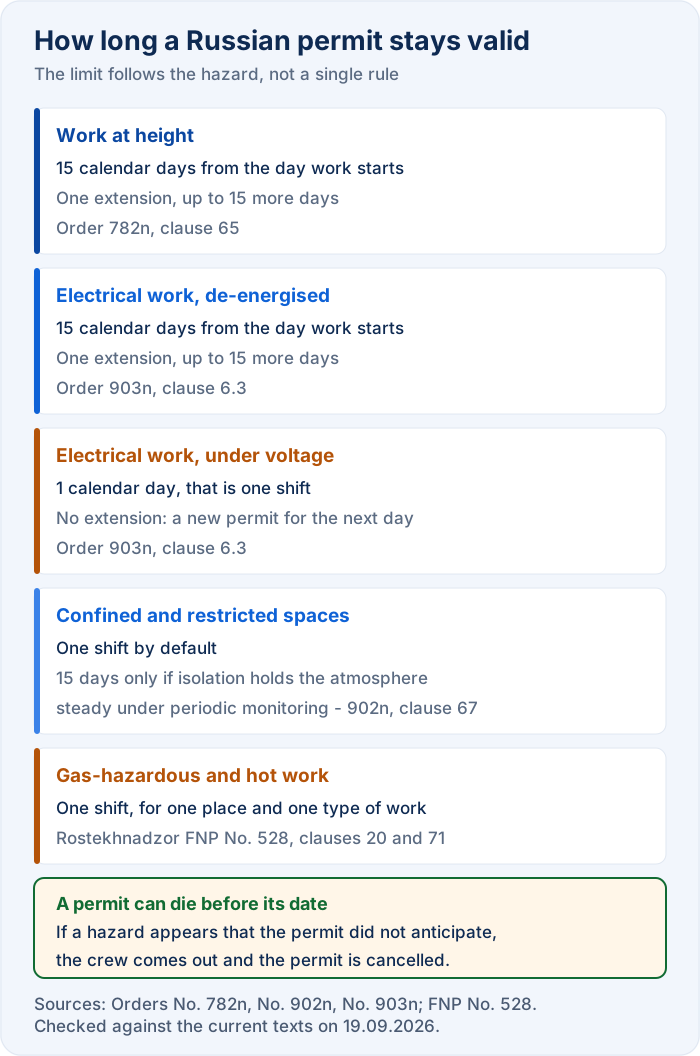
Validity follows the hazard, and the spread is wide. A single Russian site can run permits valid for one shift and permits valid for two weeks on the same day.
| Work type | Maximum validity | Extension |
|---|---|---|
| Work at height | 15 calendar days | Once, up to 15 more days |
| Electrical work, de-energised | 15 calendar days | Once, up to 15 more days |
| Electrical work, under voltage | 1 calendar day, one shift | None. New permit for the next day |
| Confined spaces | One shift by default | Up to 15 days when isolation holds the atmosphere stable |
| Hot work and gas-hazardous work | One shift | Set by the applicable rules |
The confined space entry is the one people misread. Clause 67 of Order No. 902n makes one shift the default. It allows 15 calendar days only where the isolation arrangements hold the atmosphere in the working zone constant, and only where periodic monitoring confirms that through the whole period. The single extension runs on the same condition, and without that monitoring the permit lasts a single shift.
The clauses behind the table are 65 of Order No. 782n, 6.3 of Order No. 903n, 67 of Order No. 902n, and 20 and 71 of FNP No. 528.
The full table by work type, with the extension procedure, sits in the guide to permit validity periods.
A permit also dies before its date. If a hazard appears that the document did not anticipate, the crew comes out, the permit is cancelled, and a new one is issued for the changed conditions. Accidents cluster exactly there, in the moment when conditions changed and the paper did not.
When may work start without a permit to work?
Russian rules carve out three exceptions, and each is narrower than it first looks.
Routine work by a permanent crew. Clause 8 of Order No. 782n lets work run without a permit under the employer's safety management system on two grounds. The first is work where the employer's own measures hold the risk of a fall at the acceptable minimum. The second is periodically repeated work that is an inseparable part of an ongoing technological process, with the place, the conditions and the character of the work constant, collective protection in place, and a defined, permanent crew of qualified people. The safety measures then have to live in method cards, safety instructions or production instructions instead. "We always do it this way" is not the test. A written procedure is.
Emergency response. Work to prevent an accident, remove a threat to workers' lives, or deal with the consequences of an accident or a natural disaster may start without a permit. The paperwork does not vanish, it changes form: under clause 49 of Order No. 782n such work runs under officers the employer has appointed for it, and clause 52 of Order No. 902n requires a written decision by the employer or the officer responsible for the job. If the work runs longer than 24 hours, the permit becomes mandatory.
Current operation in electrical installations. A defined list of routine operations runs without a permit under Order No. 903n. The employer approves that list, which again puts the boundary inside the company rather than in the law.
Two of the three exceptions depend on documents the employer wrote. Which is why the first question on any new Russian site is not "what does the law say" but "show me your list". Which jobs sit on it is covered in the guide to work that requires a permit.
What does a foreign contractor need to know?
Four things, and none of them appear in the orders as a single section.
The permit belongs to the employer of the crew. When a contractor brings its own people, the contractor issues the naryad-dopusk. The site owner issues an admission act, the akt-dopusk, which is Annex No. 1 to Order No. 883n and covers work on the territory of an operating organisation. Both documents exist for the same job, and both sides sign. The client does not hand its safety duties to the contractor by signing; the duty to provide safe conditions on its own territory stays with it.
The document is a Russian-language record. The permit an inspector reads is in Russian. A bilingual working copy for the crew is sensible and common, and it changes nothing about which version counts.
Your own permit system is welcome and insufficient. Running an internal permit alongside the Russian one is normal practice on international projects. It does not substitute for the prescribed form.
Training has to be Russian training. Decree No. 2464 sets who must be trained, in what programme and how often, and clause 55 puts people responsible for high-risk work on a programme of their own. The decree says nothing about training completed abroad, which is exactly the point: a foreign certificate does not satisfy a requirement written for a named Russian programme. Admitting a worker without that training is a separate offence with its own fine, which inspectors in practice count per worker.
For crews arriving from a jurisdiction with a strong permit culture, the adjustment is less about safety thinking and more about paperwork discipline. The hazards are the same. The evidence trail is stricter.
What happens if the permit is missing?
There is no article of Russian law that fines you for a missing permit as such. The penalty follows the safety rule that the missing permit allowed you to break, and the site where it happened. Article 5.27.1 of the Code of Administrative Offences covers occupational safety breaches on an ordinary site, and it prices each kind of failure separately. A general first breach, which is where a missing permit lands, carries a warning or a fine of 50,000 to 80,000 RUB on the company, roughly $591 to $946. Letting a worker start without the required training costs 110,000 to 130,000 RUB, about $1,301 to $1,538, and missing protective equipment 130,000 to 150,000 RUB, or $1,538 to $1,774. The Code itself sets no per-head multiplier; counting these per worker is enforcement practice, not the text of Article 5.27.1. A repeat offence runs 100,000 to 200,000 RUB, roughly $1,183 to $2,366, or suspension. On a hazardous production facility Article 9.1 applies instead, at 200,000 to 300,000 RUB, that is $2,366 to $3,548, and where the breach is classed as gross it runs 500,000 to 1,000,000 RUB, or $5,914 to $11,828. A serious injury moves the case into the Criminal Code.
Suspension of operations for up to 90 days is a penalty in its own right, and for most sites the idle time costs more than the fine. A judge orders it in the general case, including under Article 5.27.1, but for a gross industrial-safety breach under Article 9.1 the suspension is ordered by Rostekhnadzor officials rather than a court, which makes it a great deal faster. It also follows an expired permit that nobody renewed in time. The full breakdown by article, with the criminal thresholds, is in the guide to penalties for working without a permit.
USD amounts here are approximate, converted at the Bank of Russia official rate of 84.5449 RUB/USD as of 15 August 2026.
Can a Russian permit to work be issued electronically?
Yes, and two different clauses say so. Clause 31 of Order No. 833n allows the permit itself to be drawn up and issued in electronic form. Clause 9 of Order No. 782n allows occupational safety records in general to be kept electronically, using an electronic signature or any other method that reliably identifies the worker, and clause 67 of the same order extends that to the permit register and to signing permits, provided the employer fixes the possibility in its own internal documents. The same permission runs through the other safety rules of the 2020 to 2021 generation.
That single clause is doing a lot of work on large Russian sites right now. Paper permits fail in predictable ways: the form is issued but never closed, the extension is verbal, the crew list is amended with a pen and no countersignature, the archive loses the document before the retention period ends. An electronic permit closes those gaps by construction, because the system will not let an unsigned field pass.
Where the electronic route still stumbles is the inspection itself. An inspector arriving on site expects to be handed a document. A tablet with a signed record satisfies the rule, and it works most smoothly when the operator can also print a signed copy on request. Worth arranging before the first visit, not during it.
If you want to see what a structured digital permit looks like end to end, our team is building one at Smart Permit.
What do inspectors find wrong most often?
The failure modes repeat across industries, and none of them are exotic:
- The work supervisor field is empty, or names someone who is not on site. The permit is void.
- The targeted briefing was signed but not delivered. An inspector proves this in one minute by asking a worker what the hazards are.
- The crew on site differs from the crew on paper. Five names on the form, seven people working, or two of the five absent with no recorded replacement: each version of that mismatch invalidates the document.
- No appointment order behind the issuer's signature. Inspectors ask for the order.
- The permit expired and the job continued instead of being re-issued, which is the failure that turns a paperwork slip into an uncontrolled job.
- Combined hazards covered by one hazard's permit. Hot work at height needs both sets of measures, in one document or in two.
- Measures written as slogans. "Observe safety requirements" is not a measure. Which barrier, placed where, checked by whom, at what interval, is.
The seventh is the one I would fix first on any new site. It is the cheapest to correct and the most visible in an audit, because a permit full of generic phrases tells the inspector that nobody assessed this particular workplace.
Where to go next
The permit itself is one document in a wider system: a list of high-risk work, appointment orders, training records, a register of issued permits, and a retention rule that varies by hazard from 30 days to a year. That last figure holds only while nothing happens. Once a permit is drawn into the file of an accident investigation it is kept with that file, for decades. Getting the permit right without the supporting documents produces a paper that fails on the first question about authority.
Start with three checks on your site. Does an approved list of high-risk work exist, and does it match what the crews actually do? Does a current appointment order back every signature? Does the form you use match the order that covers the hazard? Those three answers predict most inspection outcomes.
Related guides on this site cover gas-hazardous work permits, permits in electrical installations, and which activities require a permit at all.
This page is reference information about Russian occupational safety regulation, not legal advice. Legal texts are linked in Russian at their official sources.
Frequently Asked Questions
What is a naryad-dopusk in Russian workplace safety?
A naryad-dopusk is the Russian permit to work. It is a written order, signed before the job starts, that states the task and its location, names the crew and the three responsible officers, lists the hazards and sets the safety measures. Ministry of Labour Order No. 782n of 16 November 2020 prescribes it for work at height, Order No. 903n of 15 December 2020 for electrical installations, and Order No. 902n of the same date for confined spaces.
Is a permit to work legally required in Russia?
Yes, for work the employer has placed on its own list of high-risk jobs. Article 214 of the Labour Code makes the employer responsible for safe conditions, and each set of industry safety rules names the jobs that need a written permit. Order No. 776n of 29 October 2021 supplies the model list that employers start from, so the exact scope differs from one company to the next.
How long is a Russian permit to work valid?
It depends on the hazard, not on a single rule. Work at height and de-energised electrical work run up to 15 calendar days, extendable once by another 15. Electrical work under voltage is limited to one calendar day. Confined space work is normally one shift and reaches 15 days only when isolation keeps the atmosphere stable under periodic monitoring.
Who signs a Russian permit to work?
Three officers plus the crew. The issuer, appointed by company order, decides the safety measures and answers for the crew being qualified for the job. The responsible manager checks the workplace is ready and gives the crew its targeted briefing. The work supervisor runs the job on site and must stay there. In electrical installations Order No. 903n adds a fourth figure, the admitting officer.
Can a foreign contractor use its own permit form in Russia?
Only as an addition, never as a replacement. The permit that a Russian inspector reads must follow the Russian order that covers the hazard, in Russian, with the signatures the form requires. Many international contractors run their own permit in parallel for internal control, which is allowed, and issue the Russian permit for the same job.
Sources
- Ministry of Labour Order No. 782n of 16.11.2020, safety rules for work at height (in Russian)
- Ministry of Labour Order No. 903n of 15.12.2020, safety rules for electrical installations (in Russian)
- Ministry of Labour Order No. 902n of 15.12.2020, safety rules for confined spaces (in Russian)
- Ministry of Labour Order No. 883n of 11.12.2020, safety rules in construction (in Russian)
- Ministry of Labour Order No. 776n of 29.10.2021, model occupational safety management system (in Russian)
- Government Decree No. 2464 of 24.12.2021 on occupational safety training (in Russian)
- Labour Code of the Russian Federation, Articles 214 and 215 (in Russian)
- Rostekhnadzor Order No. 528 of 15.12.2020, federal norms and rules for gas-hazardous, hot and repair work (in Russian)
- Ministry of Labour Order No. 833n of 27.11.2020, safety rules for placing, installing, servicing and repairing equipment (in Russian)
- Code of Administrative Offences of the Russian Federation, Articles 5.27.1 and 9.1 (in Russian)

Smart Permit electronic system: ready-made templates for all types of work, electronic signature, automatic log, deadline reminders. Save up to 70% of permit processing time. A single document in Excel takes 40 minutes. In Smart Permit: 3 minutes.