Smart Permit electronic system: ready-made templates for all types of work, electronic signature, automatic log, deadline reminders. Save up to 70% of permit processing time. A single document in Excel takes 40 minutes. In Smart Permit: 3 minutes.
A gas-hazardous work permit (Russian: naryad-dopusk na gazoopasnye raboty) is the written authorisation that Russian law requires before any job that may release flammable, toxic or inert gas at a hazardous production facility (HPF). Running Group I work without it exposes the company to a fine up to 1,000,000 RUB (~$11,800 at the Bank of Russia rate of 84.5 RUB/USD, August 2026) or suspension of the facility for up to 90 days, under Article 9.1(3) of the Code of Administrative Offences - the article offers the two as alternatives, not as a package. This guide explains, for expatriate HSE managers and foreign contractors operating in Russia, which operations need the permit, who signs and approves it, how to complete the form, and how long it stays valid and on file.
1. What gas-hazardous work is and why the permit matters
Gas-hazardous work covers operations where flammable, toxic or inert gases may enter the work area at concentrations that can cause an explosion, fire, poisoning or asphyxiation. Typical examples are tie-ins to live gas pipelines, repair of equipment that held hazardous substances, opening and cleaning vessels, and the first gas start-up. The employer approves a list of such operations and splits them into Group I and Group II by hazard level. The group decides whether a written permit is required or a register entry is enough.
In Western terms this is a permit to work (PTW) system, close to the hot-work and confined-space permits familiar from OSHA and HSE UK practice. Russia codifies it more rigidly: the form, the responsible roles and the gas-rescue sign-off are all prescribed by federal rules. The permit does three things: it fixes the set-up and safety measures, it assigns personal responsibility for preparation and for running, and it sets the crew, the protective equipment and the gas-test routine. The wider system is covered in the permit to work reference, and the way Russian practice splits jobs between a permit and a verbal order is set out in work under a permit to work.
In practice: Rostekhnadzor data puts poor permit paperwork among the most frequent findings at chemical and oil-and-gas hazardous production facilities. The usual remarks: fields left half-filled, no site layout attached, the crew admitted without air-test results, no sign-off from the emergency rescue service.
2. Legal basis: FNP 528 and related acts
The primary act is the Federal Norms and Rules "Safe Conduct of Gas-Hazardous, Hot and Repair Work", approved by Rostekhnadzor Order No. 528 of 15.12.2020 (FNP No. 528). It took effect on 01.01.2021. Its validity was extended to 01.09.2032 by Rostekhnadzor Order No. 62 of 03.03.2026, and the current revision dates from 03.03.2026 (in force from 09.05.2026). Check that this is still current before you rely on it: expiry dates for FNP are moved from time to time as the regulatory-guillotine reform runs on.
| Act | Scope | Application |
|---|---|---|
| Rostekhnadzor Order No. 528 of 15.12.2020 (FNP) | Safe conduct of gas-hazardous, hot and repair work | HPFs where such work is performed |
| Rostekhnadzor Order No. 531 of 15.12.2020 (FNP) | Safety of gas distribution and consumption networks | Pipelines, gas control points, gas equipment |
| Rostekhnadzor Order No. 534 of 15.12.2020 (FNP) | Safety in the oil and gas industry | Drilling, production, field development |
| Rostekhnadzor Order No. 440 of 13.11.2020 (FNP) | Industrial safety in mining and metallurgy | Gas-hazardous areas of metallurgy |
| Ministry of Labour Order No. 884n of 11.12.2020 | Occupational safety in electric and gas welding (rev. 29.04.2025, in force to 01.09.2031) | Welding at gas-hazardous sites |
| Ministry of Labour Order No. 776n of 29.10.2021 | Model OHS management regulation; Annex No. 2 lists high-risk work | Gas-hazardous work appears as an example |
| Gov. Decree No. 2464 of 24.12.2021 | OHS training and knowledge testing | Programme "V" for high-risk work |
A common error among foreign teams is to assume one general standard applies. It does not. Clause 4 takes six groups of facilities and work outside the scope of FNP No. 528:
| Outside the scope of FNP No. 528 (clause 4) | Condition stated in the clause itself |
|---|---|
| Construction, installation and commissioning work during construction or reconstruction on a fenced-off part of a live HPF | Only where the site is enclosed by solid fire-resistant structures at least 2.2 m high and ingress of vapours and gases from the live process is excluded (sub-clause "a") |
| HPFs of the mining and metallurgical industry | Sector rules: Order No. 440 |
| HPFs of heat and electric power | Except fuel-yard areas, fuel-oil storage areas and diesel power plant areas that hold and move flammable substances listed in sub-clause "c" of clause 1 of Annex 1 to Federal Law No. 116-FZ |
| Gas distribution and consumption networks - external and internal pipelines, gas-using equipment | To the extent covered by the technical regulation approved by Government Decree No. 870 of 29.10.2010; sector rules: Order No. 531 |
| Facilities using liquefied petroleum gas: filling stations and points, cylinder stores, tank installations; LPG, CNG and cryogenic vehicle refuelling stations | - |
| Linear facilities of trunk oil, gas, gas-condensate and product pipelines; drilling, production and field development facilities | Only on condition that requirements for gas-hazardous work are set by sector industrial-safety acts or, failing those, by the operator's own documents agreed with the PASS(F) and drafted in line with FNP No. 528 |
Read the last row twice. The exclusion there is conditional: with no sector act and no agreed in-house documents, there is nothing to work under instead of FNP No. 528. And only linear facilities are out - for the remaining trunk-pipeline facilities and underground gas storage the Rules apply, and clause 23 lets them replace the PASS(F) sign-off with a sign-off by a separately appointed certified officer, with notice to the PASS(F). More on regulatory rules: which acts set the permit rules.
3. Group I and Group II by hazard level
Under clause 12 of FNP No. 528, gas-hazardous work is split into two groups:
| Parameter | Group I | Group II |
|---|---|---|
| Written permit | Mandatory | Not required |
| Logging | Permit + permit register | Register of work done without a permit |
| Nature | High risk of explosion and poisoning | Recurring operations, part of the process |
| Crew | At least two people (clause 37) | A defined set of workers; the Rules do not fix a number (clause 19) |
Drawing up and approving the list
Every structural unit must have its own list of gas-hazardous work split into the two groups (clause 13); clause 14 sets what the list contains, and the head of the structural unit draws it up and obtains the sign-offs (clause 15). The head of the operator (or an authorised deputy or branch head) approves the list and re-approves it at least once a year and whenever the process or the process flow diagram changes (clause 16). The list is agreed with the gas-rescue unit (PASS(F)) and the production-control service. Any operation not on the list is done under a permit and added to the list within ten days (clause 17).
Typical Group I operations by industry
What lands in Group I depends on the industry and the process. These are the operations that usually require a permit:
| Industry | Typical Group I operations |
|---|---|
| Refining and petrochemicals | Opening and cleaning tanks, columns and reactors; repair of shut-off valves on hydrocarbon lines; replacing packing on equipment holding explosive media |
| Gas distribution and consumption | First gas start-up, tie-in to a live pipeline, cut-out by welding, replacement of pipeline sections, repair of gas control points and units |
| Chemicals | Work in areas where chlorine, ammonia or hydrogen sulphide may be released; cleaning reactors and vessels; repair of lines carrying toxic substances |
| Mining and metallurgy (Order No. 440) | Work in gas-hazardous areas of blast-furnace, coke and ferroalloy production; repair of gas-cleaning equipment |
Group II covers, for example, walking and inspecting an external pipeline route, checking wells for gas, replacing instruments without breaking containment, and taking samples for the laboratory. For the full picture of activities that require a permit, see high-hazard work.
In practice: a common error is putting Group I operations into Group II on the company list. Understating the hazard category strips the work of its protective measures, and an inspection treats that as a gross breach of industrial-safety requirements.
4. Responsible persons and sign-off
Unlike the electrical permit, FNP No. 528 has no "issuer" or "admitting officer" roles. Two responsible persons matter. The head of the structural unit appoints both from an approved list, choosing engineering-technical staff who know the safe methods of gas-hazardous work and who are not running the process during the job (clause 21). Usually they are the operator's own staff, but where a contractor does the work, the person responsible for running is a contractor engineer - under mandatory supervision by an engineer of the operator (clause 21). Replacing either of them mid-job requires a note in the permit (clause 21):
| Role | Appointed from | Duties |
|---|---|---|
| Person responsible for preparation | Engineering-technical staff of the operator | Ensures isolation, blanking, purging and cleaning of the workplace |
| Person responsible for running | Engineering-technical staff of the operator | Directs the crew, controls safety measures, stops the work when needed |
| Safety attendant | Crew member outside the vessel | Continuously watches the worker inside and keeps contact |
Managers and staff responsible for set-up and running hold industrial-safety attestation matching their duties (clause 5). Where one crew handles both set-up and running, a single supervisor may be appointed for both stages, provided that person knows the safe methods and is freed from other duties during the work (clause 21).
The permit is agreed with a professional emergency rescue service or unit (PASS(F)) certified for gas-rescue work, in-house or under contract. For a contractor, the contractor's head approves the list of its responsible persons and sends it to the client; running is run by the contractor's engineering staff under the operator's control. Who is responsible for what: who may sign a permit.
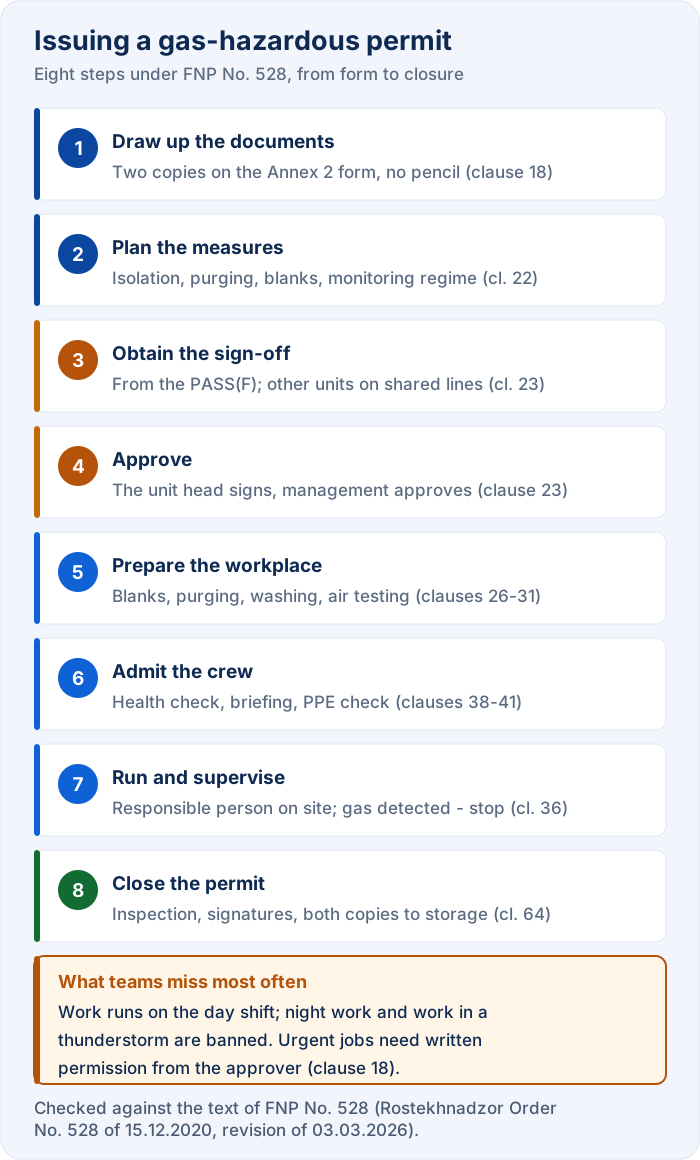
5. Issuing the permit step by step
- Documentation. A Group I permit is drawn up in two copies on the recommended form of Annex No. 2 (clause 18). It may be completed on a computer; pencil, corrections in the text, facsimile signatures and photocopies of signatures are prohibited (clause 24). The operator's PASS(F) - or another authorised service - registers the permit in the permit register under the next sequential number; that register is paginated, laced and sealed, and kept for at least six months from the day it is closed (clause 18).
- Measures. Define the scope, the hazards, the safety steps (isolation, purging, blanking), the protective equipment and the gas-test order.
- Coordination. Coordinate the permit with the PASS(F) and any other services set by internal rules.
- Approval. The head of the structural unit signs it; the head of the operator, a deputy or a branch head approves it (clause 23). A site layout signed by the unit head is attached.
- Preparation. Isolate equipment and fit blanks per the scheme, purge, wash and steam vessels, then test the air.
- Admission. Every worker is asked about their state of health first; anyone with complaints must not be assigned to the job (clause 38). The person responsible for running then briefs the whole crew on site and checks PPE, the air-test results and the readiness of firefighting and communication means. Each member signs. Entering the gas-hazardous area is allowed only with that person's permission and in protective equipment (clause 40), and the work starts in their presence (clause 41). If the crew changes, the new members are entered in the permit (clause 39).
- Execution. The responsible person stays on site throughout, controlling compliance. If conditions change or gas is detected, work stops and the crew leaves the area.
- Closure. After the job, both responsible persons inspect the workplace and sign the closure. Both copies go to storage.
The most frequent bottleneck is waiting for air-test results, so experienced engineers request the analysis while the form is still being drawn up. A step-by-step guide with samples: issuing a permit to work.
6. What the form contains
The recommended permit form is Annex No. 2 to FNP No. 528. It records the type and nature of the work; the location with equipment references; the crew; the hazardous substances with their exposure limits; the safety steps; the protective equipment; the air-test results; the isolation scheme; and the signatures of the responsible persons, the PASS(F) and the approving manager. Annex No. 2 is a recommended sample, not a mandatory form - that is the word the Rules use, and how permit forms differ across work types is covered in permit to work forms. What may not be changed is a permit already issued: entries must be legible and corrections are not allowed, so on error the form is reissued (clause 24). This matters, because an illegible or amended permit becomes a serious problem for responsible persons during an accident investigation.
7. Validity and extension
The permit is issued per location and per type of work for each crew, and it is valid for one work shift (clause 20). This is the key difference from the electrical permit, where the term reaches 15 days.
| Object | Validity | Extension |
|---|---|---|
| HPF (FNP No. 528, clause 20) | One work shift | No more than one day shift |
| Gas distribution networks (FNP No. 531) | Per Annex No. 1 to FNP No. 531 | Per sector rules |
One exception is easy to miss: where gas-hazardous work forms part of planned repair work on a facility, the permit is issued for the whole repair period, extended daily by no more than one work shift (clause 20). A fresh form for every shift is not needed in that case.
The head of the structural unit, or a substitute, may extend the permit only when all three conditions hold at once: the job is unfinished, its conditions have not changed (confirmed by air monitoring) and the nature of the work has not changed (clause 20). A new permit is issued if conditions change.
The rule on hot work is stricter than most readers expect: gas-hazardous and hot work may not be combined in the same room, or close by on an open site, where flammable or explosive substances may be released into the work area (clause 35). Where no such release is possible, each type of work gets its own permit. The same clause bans widening the scope or nature of the work beyond what the permit says. Full terms by work type: permit validity periods.
When the work may not be done at all
Work under a permit runs on working days and during the day shift. Gas-hazardous work at night and during a thunderstorm is not allowed (clause 18).
There is one exception - urgent work: first-priority work that cannot wait, aimed at preventing an accident and a threat to the life and health of the facility's workers. It may run in the dark and on weekends and public holidays, but only on the written permission of the person who approved the permit, in the presence of a PASS(F) representative (for trunk-pipeline facilities and underground gas storage - certified representatives of emergency rescue units), and with notice to everyone who signed the permit off. The permit must then set out extra measures: main and emergency lighting, additional explosion-proof luminaires where needed, personal torches or battery lamps, working communication means and air-monitoring equipment, and the continuous presence of the person responsible for running the work (clause 18).
8. Group II: work without a permit
Not all gas-hazardous work needs a permit. Group II work is done without one but is logged before it starts in the register of gas-hazardous work performed without a permit (Annex No. 3). Group II covers recurring operations that are part of the process, with a fixed location, an unchanged nature and a defined crew (clause 19), such as sampling and draining apparatus.
Emergency response is separate: localisation and clean-up of an accident proceed without a permit until the direct threat to life, health, property and the environment is removed, under the accident-response plan (PMLA). Once conditions stabilise, further work resumes under a permit. The full set of exceptions: when a permit is required at all.
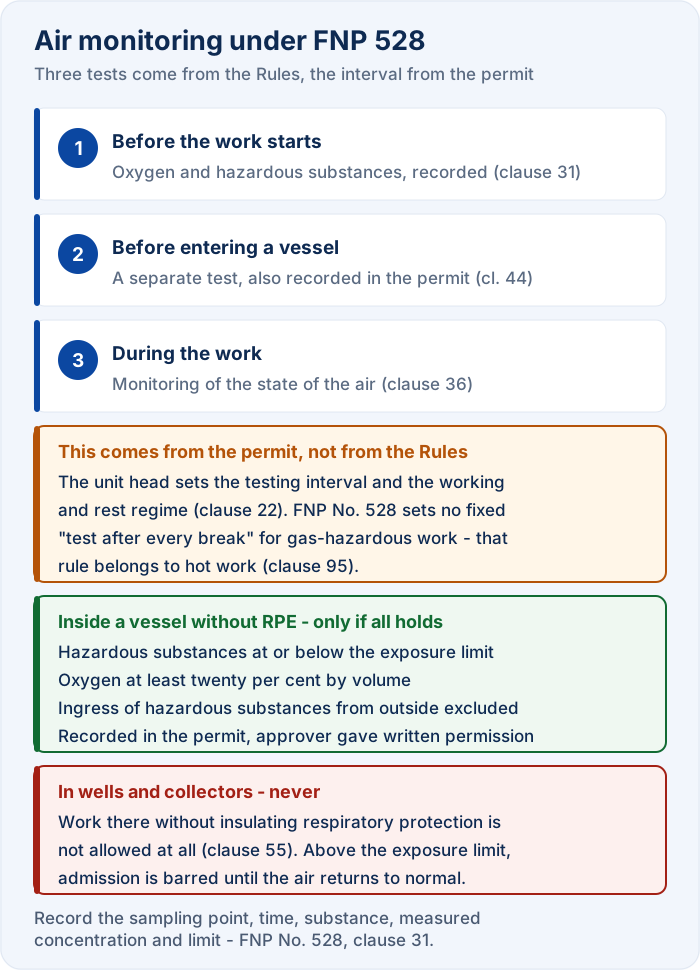
9. Air monitoring and safety measures
Air monitoring is the condition for admitting the crew, and the results go in the permit.
When the air is tested
- Before the work starts - a laboratory or express analysis for oxygen (in enclosed rooms, inside vessels, in pits) and for the hazardous substances named in the list of gas-hazardous work, with the results written into the permit (clause 31).
- Before work starts inside a vessel - a separate analysis for oxygen and hazardous substances, again recorded in the permit (clause 44).
- During the work - monitoring of the air (clause 36). The interval is set by the permit: the head of the structural unit fixes it together with the working and rest regime (clause 22).
Look closely at the third line. FNP No. 528 sets no fixed "test after every break" rule for gas-hazardous work - that rule belongs to hot work, where an analysis is required before the work starts and after any break longer than one hour (clause 95). For gas-hazardous work the moment of the repeat test is set by the permit itself, so the monitoring-interval box should carry a real interval and real triggers (a break, a change in conditions, a smell, a gas-detector alarm) rather than "as required". If the exposure limit is exceeded, admission is barred until the air returns to normal.
In practice: one frequent cause of accidents is resuming work after a break without testing the air again. Because the Rules leave the interval to the permit, the monitoring-interval field is not a formality - at that moment it works in place of the norm.
Respiratory protection
Inside vessels, workers use hose or oxygen-insulating respirators or air-supplied breathing apparatus; filtering respirators are not allowed inside vessels (clause 48). The time a worker may spend in respiratory protection in one go is set by the permit and may not exceed thirty minutes (clause 42).
Work inside a vessel without respiratory protection is possible only when every condition holds at once: hazardous substances stay at or below the workplace exposure limit, oxygen is at least twenty per cent by volume, ingress of hazardous substances from outside is excluded, this is recorded in the permit, and the person who approved the permit has given written permission (clause 53). For wells, collectors, tunnels and similar places there is no such relief at all: work there without insulating respiratory protection is not allowed (clause 55).
General safety measures
Where explosive substances may be released into the work area, the crew uses explosion-proof portable luminaires and communication means, tools and footwear that cannot spark, and respiratory protection suited to the conditions; connection points for mobile and portable electrical equipment are placed outside the hazardous zone (clause 42). No person not involved in the work may be in the area (clause 36). Firefighting means on site and a ban on smoking and open flame are ordinary site practice, but FNP No. 528 does not require either for gas-hazardous work: it calls for an extinguisher at hot work (clause 93), and the smoking ban comes from the site fire-safety regime.
10. Work inside vessels: confined-space rules
Work inside vessels, apparatus and tanks is the most dangerous category, and it maps onto what OSHA calls a permit-required confined space (29 CFR 1910.146). The Russian rules are strict in their own way:
- The vessel is freed of hazardous substances and isolated with blanks; the schemes of valve positions, product draining, washing, purging, steaming and blank locations are attached to the permit (clause 25).
- It is washed, steamed and purged, and the air is tested before entry (clause 44).
- Warning signs "Gas" and "Gas-hazardous work" are hung on the vessel and may be taken down only after the job, with the permission of the person responsible for running it (clause 45). Electric-driven agitators are isolated from power by a visible break, a "Do not switch on: men at work" sign goes up in the switchgear, and only the operator's electrical staff isolate and re-energise the drive (clause 46).
- A heated vessel is cooled to no more than 30 °C before anyone goes in. If the work has to be done hotter, extra measures apply: continuous forced fresh-air blowing, heat-protective suits, heat-insulating footwear, breaks in the work. At 50 °C and above, work inside the vessel is not allowed (clause 47).
- The crew is at least two people, one working and one attending outside (clause 49). The person responsible for running the work is present at the site (clause 49).
- The worker wears a safety belt or full-body harness with a signal-rescue line (clause 49).
- The attendant keeps continuous contact with the worker; where there is no line of sight between them, a system of agreed signals is set up in advance (clause 51).
- If more than one worker goes inside, the permit must carry extra measures: at least two attendants, the order of entry and evacuation, the layout of hoses, respirator intake pipes and signal-rescue lines, and communication and alarm means (clause 50).
- The work stops at once and the worker is evacuated on any of these signs: the worker feels unwell, tries to remove the respirator mask, the signal line breaks, the hose fails, the air blower stops (clause 58).
Admission is granted only after full preparation: isolation, blanking, steaming or purging, and a confirmed safe concentration. When the job is over, the person responsible for running it makes sure no workers, tools, materials or foreign objects are left inside before the hatches are closed, records the completion in the permit, and tells the process operators the work is finished, with an entry in the shift log (clause 61).
11. Retention period
The retention period is often confused with validity. The permit is valid for one shift but is kept much longer.
| Item | Period | Basis |
|---|---|---|
| Permit (paper, both copies) | At least 6 months from closure | FNP No. 528, clause 64 |
| Electronic permit | 1 year from closure | FNP No. 528, clause 24 |
| Permit register (Group I work) | At least 6 months from the day the register is closed | FNP No. 528, clause 18 |
| Register of Group II work done without a permit | 6 months from the day the register is closed | FNP No. 528, clause 19 |
| Permit on gas distribution and consumption networks | At least 1 year from closure | FNP No. 531, clause 143 |
| Permits for first gas start-up, tie-in, cut-out by welding (distribution networks) | Permanently, with the as-built file | FNP No. 531, clause 143 |
| Accident investigation file, including the permit attached to it | 45 years | Article 230.1 of the Labour Code |
The six-month term in clause 64 is general for any gas-hazardous work, not specific to vessels. The "three months" figure from older in-house instructions does not match the current Rules. The periods in the table are minimums: the operator sets the order and conditions of storage by its own order (FNP No. 531, clause 143). One case stands apart - an accident at work: the employer keeps a copy of the investigation report together with the file, the permit included, for 45 years (Article 230.1 of the Labour Code). Full storage table: how long a permit lasts and how long it is kept.
12. Common failures and liability
What inspectors find most often
| Failure | Consequence | Basis |
|---|---|---|
| No permit for Group I work | Fine under Article 9.1 of the Code of Administrative Offences or suspension of the activity - an alternative, not a sum | FNP No. 528, clause 12 |
| Form completed in pencil or signed by facsimile | Breach of the direct ban in clause 24 - the Rules never use the word "invalid" | FNP No. 528, clause 24 |
| No air-test results | The crew may not be admitted | FNP No. 528, clause 31 |
| No PASS(F) sign-off | Breach of the order in clause 23: approval comes after the sign-off, not before | FNP No. 528, clause 23 |
| The list of gas-hazardous work is not re-approved yearly | A finding during a Rostekhnadzor inspection | FNP No. 528, clause 16 |
| Night work or work during a thunderstorm without the written permission for urgent work | Direct breach of the Rules | FNP No. 528, clause 18 |
Administrative liability
Offences fall under Article 9.1 of the Code of Administrative Offences. The part of the article matters. Amounts are in RUB with an approximate USD figure (at the Bank of Russia official rate of 84.5 RUB/USD, 15 August 2026; check the current rate on cbr.ru).
| Offence | Officer | Legal entity |
|---|---|---|
| 9.1(1) breach of industrial-safety rules | 20,000-30,000 RUB or disqualification 6 months-1 year | 200,000-300,000 RUB (~$2,370-3,550) or suspension up to 90 days |
| 9.1(3) gross breach, except the cases in 9.1(3.1) | 40,000-50,000 RUB or disqualification 1-2 years | 500,000-1,000,000 RUB (~$5,900-11,800) or suspension up to 90 days |
Under 9.1(1) an individual citizen is fined 2,000-3,000 RUB. In every line the fine and the suspension are alternatives: the article says "or", so a company faces one of them, not both.
A gross breach is one that creates a direct threat to people's life or health (note to Article 9.1).
Criminal liability comes under Article 217 of the Criminal Code (industrial-safety violations at an HPF). Imprisonment is only one of the options, and the court chooses between them:
- part 1, serious harm to health or major damage: a fine up to 400,000 RUB or up to 18 months of the convicted person's income, or forced labour up to 3 years, or imprisonment up to 3 years;
- part 2, death of one person: forced labour up to 5 years or imprisonment up to 5 years;
- part 3, death of two or more people: forced labour up to 5 years or imprisonment up to 7 years.
The court may add a ban on holding certain positions or carrying out certain activities for up to 3 years - but it does not have to: the article says "or without such". Article 216 (safety in construction or other work) and Article 143 (occupational-safety rules) may also apply. Appointing responsible persons does not relieve the employer. What each article costs is set out in the guide on penalties for working without a permit; who does what on a permit: responsible persons; the related hot-work rules: hot work permit.
This page is a reference for foreign specialists working in Russia, not legal advice. The governing text is Rostekhnadzor Order No. 528 in its current edition.
Frequently Asked Questions
How long is a gas-hazardous work permit valid in Russia?
It is issued per location and per type of work for each crew and is valid for one work shift (clause 20 of FNP No. 528). If the job is unfinished and conditions have not changed (confirmed by air monitoring), the head of the structural unit may extend it by no more than one day shift. There is no 15-day option, unlike the electrical permit.
Who signs and who approves the permit?
The permit is signed by the head of the structural unit or a substitute, and approved by the head of the operating organisation, an authorised deputy or a branch head (clause 23 of FNP No. 528). Before approval it is coordinated with the professional emergency rescue unit (PASS(F)).
Is coordination with gas-rescue services required?
Yes. The permit is coordinated with a professional emergency rescue service or unit (PASS(F)) certified for gas-rescue work, either in-house or under contract (clause 23). It is a mandatory step BEFORE approval: a permit without that sign-off has nothing to be approved on. One exception: at trunk-pipeline facilities and underground gas storage the PASS(F) sign-off may be replaced by a sign-off from a separately appointed certified officer, with notice to the PASS(F) (clause 23). This has no exact OSHA equivalent; the closest analogue is a standby rescue arrangement.
Which gas-hazardous work is done without a permit?
Group II work: recurring operations that are part of the process, with a fixed location, unchanged nature and a defined crew (clause 19). It is logged before it starts in the register of gas-hazardous work performed without a permit. Group I always requires a written permit and a crew of at least two people (clause 37); for Group II the Rules set no crew size.
How long must the permit be kept?
Both copies are kept for at least six months from the date of closure (clause 64 of FNP No. 528). An electronic permit is kept for one year (clause 24). The "three months" figure from older in-house instructions is outdated.
Sources
- Rostekhnadzor Order No. 528 of 15.12.2020 (FNP "Rules for the safe conduct of gas-hazardous, hot and repair work"; permit forms in Annexes 2, 4 and 5)
- Federal Law No. 116-FZ of 21.07.1997 on industrial safety of hazardous production facilities
- Article 9.1 of the Code of Administrative Offences (breach of industrial-safety requirements)
- Ministry of Labour Order No. 902n of 15.12.2020 (Occupational safety rules for confined and enclosed spaces)
- Article 143 of the Criminal Code of the Russian Federation (violation of occupational safety requirements)
- Article 217 of the Criminal Code of the Russian Federation (violation of industrial safety requirements at hazardous production facilities)
- Article 230.1 of the Labour Code of the Russian Federation (registration of occupational accidents; investigation files kept for 45 years)
- Rostekhnadzor Order No. 531 of 15.12.2020 (FNP "Safety of gas distribution and consumption networks"; gas-hazardous work permit form in Annex No. 1)
- Rostekhnadzor Order No. 534 of 15.12.2020 (FNP "Safety rules in the oil and gas industry")
- Ministry of Labour Order No. 776n of 29.10.2021 (Model regulation on the OSH management system; Annex No. 2 - indicative list of high-risk work)
- OSHA 29 CFR 1910.146, Permit-Required Confined Spaces (US comparison)

Smart Permit electronic system: ready-made templates for all types of work, electronic signature, automatic log, deadline reminders. Save up to 70% of permit processing time. A single document in Excel takes 40 minutes. In Smart Permit: 3 minutes.