Smart Permit electronic system: ready-made templates for all types of work, electronic signature, automatic log, deadline reminders. Save up to 70% of permit processing time. A single document in Excel takes 40 minutes. In Smart Permit: 3 minutes.
Fifteen days, one shift, or one day? The validity period of a Russian permit to work (Russian: naryad-dopusk) depends entirely on the type of work and the act that governs it, and getting it wrong is expensive. Working under an expired permit carries a fine under part 1 of Article 5.27.1 of the Code of Administrative Offences: 50,000 to 80,000 RUB (~$590-950 at the Bank of Russia rate of 84.5 RUB/USD, August 2026) for the organisation, rising to 200,000 RUB (~$2,370) on a repeat offence under part 5. If a worker is seriously hurt, the case moves into criminal territory under Article 143 of the Criminal Code. This guide gives the exact terms, extension rules and storage requirements for every major category of high-risk work, written for expatriate HSE managers and foreign contractors who must reconcile Russian permit rules with their own - OSHA in the United States, the HSE regime in the United Kingdom.
How long a permit-to-work is issued for: two approaches
Since 2021 Russia has had no single law setting one validity period for all high-risk work. The old standard regulation (POT RO 14000-005-98) was repealed and never replaced by a unified document. Each type of work is now governed separately. The Ministry of Labour issues Labour Protection Rules (Russian: Pravila po okhrane truda, or POT). Rostekhnadzor - the Federal Service for Environmental, Industrial and Nuclear Supervision - issues Federal Norms and Rules (FNP) for hazardous production facilities (HPF).
In practice an HSE engineer has to hold not one term in mind but a whole table. And one detail teams often forget: where two acts overlap on a site (say, hot work at height on an HPF), the stricter limit applies.
There are two basic approaches.
First, a fixed maximum of 15 calendar days. This is how most Ministry of Labour rules work. The permit is issued for no more than 15 days from the start date, with one extension of a further 15 days. The cap on a single form is 30 days. Work at height, painting and several other categories follow this scheme. Confined and enclosed spaces belong to it only conditionally: there the permit runs for one shift, and the 15 days become available only where blocking arrangements hold the atmosphere steady and periodic monitoring confirms it (clause 67 of Order No. 902n).
Second, one work shift. For gas and hot work at HPFs, Rostekhnadzor set a very different bar through Order No. 528 of 15.12.2020. The permit is valid for exactly one work shift. It can be extended by no more than one further shift, and only if conditions are unchanged. The gap with Ministry of Labour rules is enormous: one shift (usually 8 to 12 hours) against 15 days.
What about electrical installations? Here the Ministry of Labour introduced a hybrid model. Order No. 903n splits the rule: de-energised work runs up to 15 days with extension; live work on conductive parts is strictly 1 calendar day, with no extension, so a new permit is needed.
Confusing? It is. The legal basis was built up over decades, with different agencies responsible for different risks. The table below saves hours of searching through ConsultantPlus, the legal-reference database Russian practitioners actually use.
Summary table of validity periods for all types of work
This is the central table of the article. Print it and pin it to the HSE board. The permit form itself differs from act to act, and which permit form applies to which work is a separate question from how long it lasts.
| Type of work | Max. issue term | Extension | Act (order, clause) | Storage |
|---|---|---|---|---|
| Work at height | 15 cal. days | once, 15 cal. days | Min. of Labour No. 782n, cl. 65 | 30 days (cl. 66) |
| Electrical, de-energised | 15 cal. days | once, 15 cal. days | Min. of Labour No. 903n, cl. 6.3 | 1 year (cl. 6.5) |
| Electrical, live | 1 cal. day | not allowed | Min. of Labour No. 903n, cl. 6.3 | 1 year (cl. 6.5) |
| Gas work, HPF | 1 work shift | +1 shift | Rostekhnadzor No. 528, cl. 20 | at least 6 months (cl. 64) |
| Gas/hot work, trunk pipelines | 10 days | up to 15 days (extension, not total) | superseded No. 485; now No. 528 | at least 6 months |
| Hot work, HPF | 1 work shift | +1 shift | Rostekhnadzor No. 528, cl. 71 | at least 6 months (cl. 105) |
| Confined spaces (OZP) | One shift; 15 cal. days only where the atmosphere stays steady under periodic monitoring | once, 15 cal. days, on the same conditions | Min. of Labour No. 902n, cl. 67 | 1 year (cl. 71) |
| Painting | 15 cal. days | once, 15 cal. days | Min. of Labour No. 849n, cl. 9 | 1 year (cl. 12) |
| Construction, reconstruction | for the assigned scope | per the act for the work | Min. of Labour No. 883n, cl. 25 | 1 year (Rosarkhiv No. 236) |
| Metal coatings | for the assigned scope | per the act for the work | Min. of Labour No. 776n, cl. 14 | 1 year (Rosarkhiv No. 236) |
| Road works | set by the employer's own act | not regulated by the order | Min. of Labour No. 882n, cl. 12 | 1 year (Rosarkhiv No. 236) |
Current as of 4 September 2026. Most of these rules run until 1 September 2031, but check two rows before you rely on the date: the metal-coatings rules (Order No. 776n of 12.11.2020) expire on 1 September 2027, and Rostekhnadzor Order No. 528 runs to 1 September 2032. For disputed cases, check the primary source through ConsultantPlus or Garant (both in Russian).
A note on the trunk-pipeline row. Rostekhnadzor Order No. 485 of 20.11.2017 was repealed from 1 January 2021 (under Government Decree No. 1192 of 06.08.2020) and replaced by Order No. 528. The figure of "10 days, extension up to 15 days" came from clause 1.10 of No. 485, where the 15 days was the extension period, not a 10+5 cumulative total. Cite No. 528 for any current gas or hot work on trunk pipelines.
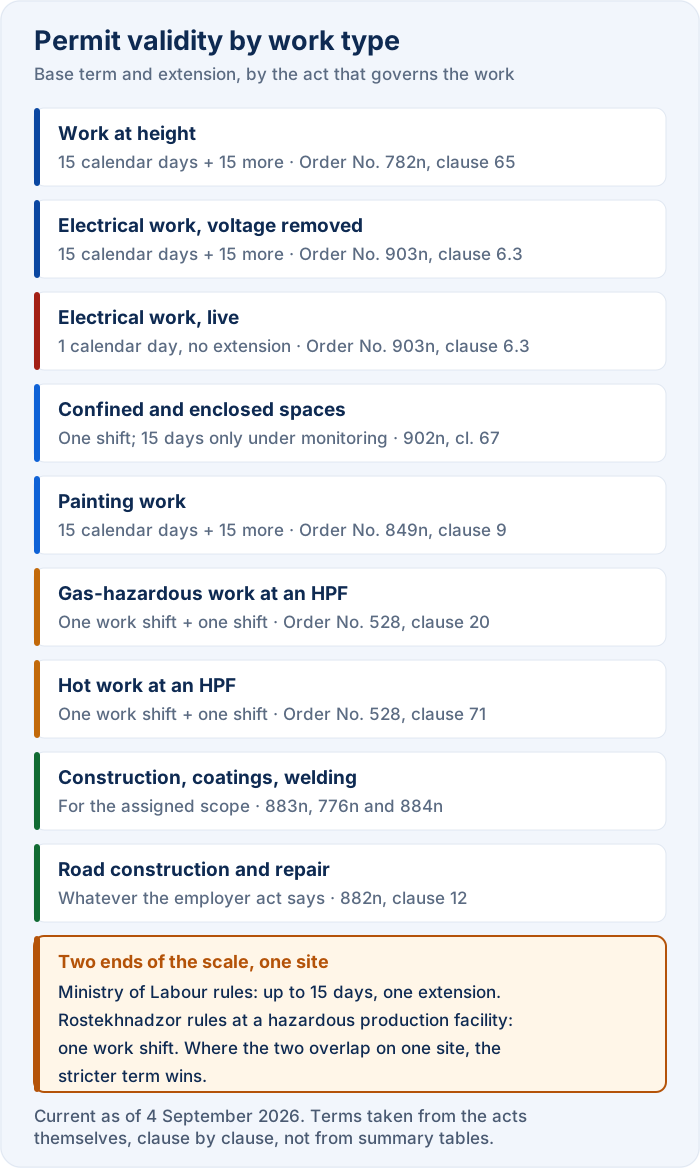
Printable infographic: permit-to-work validity periods by type of work. Print on A4 and pin to the HSE board.
Ministry of Labour vs Rostekhnadzor: two approaches to terms
To navigate faster, remember the main split: the validity period follows whichever agency regulates your site.
| Parameter | Ministry of Labour rules (POT) | Rostekhnadzor norms (FNP) |
|---|---|---|
| Where it applies | All organisations | Hazardous production facilities (HPF) |
| Base term | 15 calendar days | 1 work shift |
| Extension | once, 15 days (30 total) | once, 1 shift (2 total) |
| Storage | varies (30 days to 1 year) | at least 6 months to 1 year |
| Examples | height, confined spaces, painting | gas, hot work at HPFs |
| Where two acts conflict | the stricter one applies | the stricter one applies |
This split has no direct OSHA analogue. In the US a single permit-to-work programme - a hot-work permit under 29 CFR 1910.252, say - is usually set by the employer's own procedure. Two separate federal agencies imposing different validity limits on the same site is a Russian arrangement. Where the whole family of Russian permits sits relative to one another is mapped in the guide to permit-to-work categories.
Work at height: 15 days and not a day more
Legal basis: Ministry of Labour Order No. 782n of 16.11.2020, rev. 29.04.2025. In force until 01.09.2031.
Clause 65 sets the limit: a permit may be issued for no more than 15 calendar days from the start date. One extension of a further 15 days is allowed. The cap on a single form is therefore 30 calendar days. That is all.
Breaks do not stop the clock. Weekends, holidays, rain, frost and high wind do not cancel the permit. A break does not reset the clock. The document stays valid until the 15-day (or 30-day with extension) term runs out. On wind: clause 45 of Order No. 782n does not ban work outright at 15 m/s (34 mph). It requires that open-air work at a wind speed of 15 m/s and above be carried out under a permit with risk-reduction measures, rather than prohibiting it. The old rules (Order No. 155n) imposed an outright ban above 15 m/s; the current rules replaced that with a permit regime.
In practice it works like this: a crew works three days, then a week of rain, then five more days. That is 15 calendar days from the start, though they actually worked only eight. Formally the permit term is over. To continue, you either extend it (if the extension has not been used) or close the current form and issue a new one.
When a permit is cancelled early. Under clause 65, if hazardous or harmful factors not provided for in the permit arise, the responsible manager stops the work and the permit is cancelled. Separately, clause 69 requires a new permit when the responsible manager or the work supervisor is replaced, when the crew changes by more than half, or when working conditions change. Note that this is not any single change of one crew member; it is a change of more than half, or a change of the named officers or conditions.
In all these cases work stops immediately, the permit is cancelled, and it can only resume after a new form is issued with a fresh targeted briefing for the whole crew.
What clause 69 does not ban is adding a person as such, and this is where site practice most often goes wrong in the opposite direction. The first paragraph of the clause lets the responsible manager temporarily bring workers into the crew, in agreement with the person who issued the permit, as long as the crew changes by less than half in total. The instruction may come by telephone or radio. The officer who receives it then writes the name of the person who gave it into the permit, under his own signature. The responsible manager must then brief everyone brought in. Full procedure: how to issue a permit to work, step by step. The complete guide to work at height is in the Hub section.
Storage. A closed form is kept for 30 days from closure (clause 66 of Order No. 782n), after which it may be destroyed. Note what the rules actually say here: clause 67 only governs how work is logged (in the register of permit work, with an electronic option allowed). It sets no storage period, and the often-quoted "1 month for the journal" figure is not in Order No. 782n. Compare this with electrical installations, where documents are kept for 12 months: the difference is real.
Electrical installations: two different regimes
Legal basis: Ministry of Labour Order No. 903n of 15.12.2020, rev. 29.04.2025. In force until 01.09.2031.
The key difference from other work: the validity of an electrical permit depends on whether the conductive parts are de-energised or not.
| Condition | Term | Extension | Basis |
|---|---|---|---|
| Work with voltage removed | up to 15 cal. days | once, 15 cal. days | cl. 6.3, Order No. 903n |
| Live work | 1 cal. day (one shift) | not allowed, new form needed | cl. 6.3, Order No. 903n |
| Breaks | document stays valid | no effect | cl. 6.3, Order No. 903n |
Why is the live-work term stricter? The cost of an error is far higher. In de-energised work the main risks are mistaken energising or induced potential. In live work, any imprecise movement can cause electric shock. The rule caps the term at one day: each shift gets a fresh form, a new targeted briefing, and a fresh assessment of conditions.
The number of permits issued for one responsible manager is decided by the person issuing them (clause 6.2 of Order No. 903n). Read the second paragraph of that clause carefully, because it is easy to misread: the issuer may hand out several permits and written instructions at once, but to the admitting officer together with the work supervisor, or to the admitting officer together with the observer - and only for admission and work one after another. In practice this is needed when a crew moves between several switchgear bays or sections during the day.
Storage. Closed electrical permits are kept for 12 months (clause 6.5 of Order No. 903n), after which they may be destroyed. Electrical injuries often have delayed effects, and the records may be needed for an investigation months later. Where an accident, incident or injury occurred on the work covered by the permit, clause 6.5 takes it out of the 12-month rule altogether: the permit goes to the company archive with the investigation file, and it is the retention period of that file that then applies.
A frequent question: is a permit needed for measurements and tests in electrical installations? Yes, if the work is on the list approved by the employer. Insulation-resistance measurement, high-voltage testing and relay-protection checks are usually done under a permit. A written instruction (Russian: rasporyazhenie) is not a verbal order, whatever the usual translation suggests: clause 7.1 of Order No. 903n defines it as a written task setting the content, place, time, safety measures (where any are required) and the workers assigned, with their safety groups. It is one-off, and it lapses at the end of the working day or shift. It is used for simpler work that does not require a full permit. Choosing the wrong way to authorise the job - a permit where a written instruction would do, or the other way round - is logged by inspectors as a violation. The full guide to electrical installations is in the Hub section.
Gas work at HPFs: shift-by-shift control
Legal basis: Rostekhnadzor Order No. 528 of 15.12.2020.
The base rule (clause 20): a gas-hazardous work permit is issued for each location and each type of work, for each crew. It is valid for one work shift. This is the strictest of all the rules covered here.
If the work is unfinished and conditions are unchanged, the head of the structural unit (or a deputy) may extend the permit, but by no more than one day shift. The mandatory condition: air-monitoring results confirm safety. Without an air-monitoring record, no extension is possible. The scope and nature of the work written in the form may not be increased. If the crew needs to do extra operations not in the document, a new permit is issued.
Three regimes for different situations
| Situation | Term | Extension | Basis |
|---|---|---|---|
| Standard gas work at HPF | 1 work shift | +1 day shift | Order No. 528, cl. 20 |
| Gas work within planned maintenance | whole maintenance period | daily, by 1 shift | Order No. 528, cl. 20 (last para) |
| Trunk pipelines (superseded act) | 10 days | up to 15 days (extension, not total) | superseded No. 485; now No. 528 |
Planned maintenance deserves a separate note, and so does the clause number, which is widely quoted wrong. The rule sits in the last paragraph of clause 20: where gas work forms part of planned maintenance, the permit is issued for the whole maintenance period. Clause 71 says the same for hot work. (Clause 126 is a different rule - it requires separate permits for the repair work and for the gas or hot work, with the registration numbers of the latter written into the repair permit.) The permit must then be extended every day: the unit head confirms conditions are unchanged and air monitoring is within limits. Miss one day, and the permit lapses. On refinery audits this daily entry gets "forgotten" in roughly one case in three - an impression from site work, not a published statistic. The result is a formal violation that lands in the inspector's report.
Gas-hazardous work is split into two groups by hazard level (clause 12 of Order No. 528). Group I is done under a permit. Group II is done without one, but only after the job is entered in the register of gas-hazardous work performed without a permit - that entry is made before work starts, and its absence is itself a finding. Which operations need a permit in the first place is a separate question, answered in the guide to work that requires a permit. More detail on this family of work: gas-hazardous work permit, requirements and procedure.
Hot work: Rostekhnadzor's tight limits
Legal basis: the same Rostekhnadzor Order No. 528 of 15.12.2020.
Clause 71: a hot-work permit at an HPF is valid for one work shift. What is the maximum here? Two shifts: the initial one plus a single extension, and the extension needs more than a nod - the conditions must be unchanged and that must be confirmed by air-monitoring results, exactly as for gas work. The one case that runs longer is planned maintenance: the same clause lets the permit cover the whole maintenance period, with a daily extension of one shift.
Combining hot and gas operations in one room is prohibited (clause 94 for hot work, mirrored by clause 35 for gas work). The same ban covers an open area, but with a boundary the rule states and summaries drop: it applies in immediate proximity, and only where flammable or explosive substances could be released into the work zone. How hard the breach lands is not fixed by Order No. 528 - the word "gross" appears nowhere in it. It comes from part 3 of Article 9.1 of the Code of Administrative Offences, and Note 1 to that article makes it conditional: a breach of industrial-safety requirements is gross when it created an immediate threat to life or health. When it does, the penalty jumps to 40,000-50,000 RUB (~$473-592) or disqualification for one to two years for an officer, and 500,000 to 1,000,000 RUB (~$5,920-11,830) or suspension of operations for up to 90 days for the organisation. Note also that the prohibition lives in clauses 35 and 94, not clause 12, which only divides gas work into groups.
And outside HPFs? At facilities that are not hazardous production facilities, hot work is governed by the Fire Safety Regulations (Government Decree No. 1479 of 16.09.2020) and sector-specific Labour Protection Rules. There the term can run up to 15 days depending on the employer's local act, since Decree No. 1479 itself sets no fixed day limit.
A familiar situation: a plant has a shop that does not fall under Rostekhnadzor's norms, and hot-work permits there run 15 days. Fifty metres away stands a unit registered as an HPF. There the same welders work on a one-shift permit. Two different terms for the same people on one site. The law is the law, and here it must be followed to the letter. Full guide: hot-work permit.
Welding and gas-cutting work
Ministry of Labour Order No. 884n of 11.12.2020 (Labour Protection Rules for electric and gas welding) deserves a separate mention, which runs to 1 September 2031 after Order No. 287n of 29.04.2025. This order does set a permit term of its own, and it is an open one: clause 26 says the permit is issued for the period needed to complete the assigned scope of work, and that if hazardous or harmful factors not allowed for in the permit arise, work stops and the permit is cancelled until a new one is issued. In practice that open term yields to whichever rules govern the work during which the welding is done, because those rules are the stricter ones. If a welder works at height, the height permit under Order No. 782n applies (15 days). If at an HPF, Rostekhnadzor Order No. 528 (one shift). If in a confined space, Order No. 902n.
In practice this causes confusion: a welding foreman does not always know which permit governs the job. Recommendation: state clearly in the form itself which act applies and which term is set. This removes ambiguity and protects you in an inspection.
Confined spaces, painting and other Ministry of Labour rules
Several types of work share the same scheme: 15 calendar days with one extension of 15 days. Whether a given job falls into any of them at all is settled first by the list of work that requires a permit. Their forms differ, though - which permit form applies to which work. Each in turn.
Confined and enclosed spaces (Ministry of Labour Order No. 902n of 15.12.2020). Wells, tanks, vessels, tunnels. The permit is issued for one shift. It may run up to 15 calendar days only where the blocking arrangements hold the atmosphere in the work zone constant and that is confirmed by monitoring the atmosphere periodically through the whole period - the extension of a further 15 days is allowed once, on the same conditions (clause 67). Drop the periodic monitoring and the 15-day option goes with it. Before the crew is admitted, the atmosphere inside must be tested. If the gas detector shows a deviation, the permit is cancelled and the crew is not admitted.
Painting work (Ministry of Labour Order No. 849n of 02.12.2020). Term: 15 days (clause 9). Extension: once, by 15 days. If harmful factors not allowed for in the form arise, work stops and a new permit is issued. One figure is worth getting right, because it is misquoted more often than any other in this group: the closed painting permit is kept for 1 year (clause 12), not 30 days.
Construction and reconstruction (Ministry of Labour Order No. 883n of 11.12.2020). Here the term is tied not to the calendar but to the scope of work. Clause 25 reads: the permit is issued for the period needed to complete the assigned scope of work, unless another act sets a different term. This is one of the categories (alongside metal coatings and road works) where the permit is issued for the work period rather than a fixed number of days. Two things are often attributed to this order and are not in it. The permit term is not tied to the PPR or POS - the Russian work-execution and construction-organisation plans - and there is no "30 days storage" rule. Order No. 883n sets no storage term of its own, so the general rule applies: under Retention Schedule No. 236 of Rosarkhiv, the Federal Archival Agency whose schedule fills the gap when a safety order is silent, a high-risk-work permit is kept for 1 year.
Metal coatings (Ministry of Labour Order No. 776n of 12.11.2020). Clause 14 sets the term openly: the permit is issued for the period needed to complete the assigned scope of work. There is no "15 + 15" rule here, despite that figure being carried across from other rules in error. Order No. 776n sets no storage term either; the general 1-year period under Rosarkhiv Retention Schedule No. 236 applies.
Road and road-repair works (Ministry of Labour Order No. 882n of 11.12.2020). This row is quoted wrong more often than any other in the table. There is no fixed "15 days" here - but there is no "for the time needed" either. Clause 12 sets no term at all: it says the procedure for high-risk work, for issuing the permit and for the duties of the officers responsible is established by the employer's own local act. Clauses 13 to 15 list the work that needs a permit, leave the list to the employer and set out the register fields. So the term on a road-works permit is whatever the employer's procedure says, and an inspector will read that procedure, not the order. Order No. 882n sets no storage term of its own; under Rosarkhiv Retention Schedule No. 236 the permit is kept for 1 year. Do not confuse this act with "construction, reconstruction and repair", which is Order No. 883n; road works are specifically No. 882n.
The pattern is plain to see. The Ministry of Labour standardised its approach: 15 + 15 days across most of its rules, except for construction, metal coatings and road works, which run on the scope and time of the work. Rostekhnadzor set its own, tighter limits at HPFs: one shift. Knowing which agency regulates a given site means knowing the permitted term.
Extending a permit-to-work: who may, how often and on what conditions
Inspectors flag breaches of the extension procedure more often than anything else. How long can a permit be extended for? It depends on the type of work. Point by point.
Who extends it
For work at height: the person who issued the permit, or another official with issuing rights named by the employer's order - the appointment side of that is covered in who issues a permit to work. In practice this is usually the chief engineer or the unit head.
For gas and hot work at HPFs: the head of the structural unit or a deputy.
Passing the extension decision by phone, radio or messenger is allowed. The mandatory condition: an entry in the relevant field of the form.
Extension summary
| Type of work | How often | Term | Mandatory condition |
|---|---|---|---|
| Work at height | once | +15 cal. days (30 total) | conditions and crew unchanged (cl. 69) |
| Electrical, de-energised | once | +15 cal. days (30 total) | conditions unchanged |
| Electrical, live | not allowed | n/a | new form each day |
| Gas, HPF | once (daily in planned maintenance) | +1 day shift | air monitoring, conditions unchanged (cl. 20) |
| Hot work, HPF | once (daily in planned maintenance) | +1 day shift | air monitoring, conditions unchanged (cl. 71) |
| Confined spaces, painting, other POT | once | +15 cal. days | conditions unchanged |
When extension is not allowed
Four situations in which the permit loses force.
First, the crew composition changed. For work at height, clause 69 of Order No. 782n requires a new permit when the crew changes by more than half, or when the responsible manager or the work supervisor is replaced. A change at that scale means a new form with a fresh targeted briefing.
Second, hazardous factors arose that were not present at issue. For example, an unknown cable is uncovered during excavation. Or weather deteriorates sharply, bringing risks the original document did not allow for.
Third, the conditions, location, nature or scope of the work changed. Crew moved to a different section? A new type of operation added? New form.
Fourth, the maximum total term expired. For work at height that is 30 calendar days (15 + 15) under Order No. 782n. For gas work at HPFs under the standard rule it is 2 day shifts (1 + 1) under the separate Rostekhnadzor Order No. 528. These are two different acts from two different agencies; do not mix the height limit with the HPF limit.
In all four cases, the current form is closed, a new one is issued, and a fresh targeted briefing is given to the whole crew.
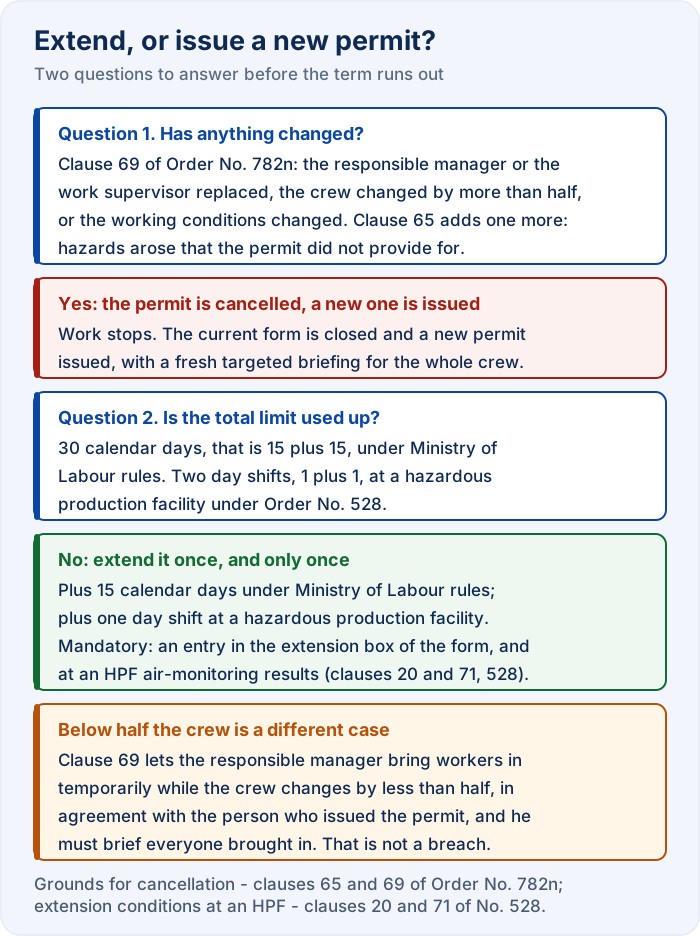
Decision algorithm: extend, cancel, or issue a new permit-to-work.
Storage of closed permits-to-work
Once work is fully complete and the workplace handed back, the form is closed and sent to storage. How long is a permit kept after closure? Confusion over these periods is as common as confusion over validity.
| Type of work | How long to keep | Basis |
|---|---|---|
| Work at height | 30 days | Order No. 782n, cl. 66 |
| Electrical installations | 12 months | Order No. 903n, cl. 6.5 |
| Gas work, HPF | at least 6 months | Order No. 528, cl. 64 |
| Hot work, HPF | at least 6 months | Order No. 528, cl. 105 |
| Confined spaces (OZP) | 1 year | Order No. 902n, cl. 71 |
| Painting | 1 year | Order No. 849n, cl. 12 |
The pattern is mixed, so read the specific act rather than assuming a single rule. Work at height is the short outlier at 30 days. Most other categories run from 6 months to 1 year. The reason is practical: investigations on hazardous production facilities and after electrical injuries develop slowly, and the effects can surface months later. The often-repeated "30 days for everything under Ministry of Labour rules" is wrong: painting (Order No. 849n) and confined spaces (Order No. 902n) both store for 1 year.
A separate nuance for HPFs: the "at least 6 months" applies to a paper permit. A permit for gas or hot work issued as an electronic document is kept for one year from closure (Order No. 528, clause 24 for gas work and clause 82 for hot work).
The main exception: after an accident, incident or injury, the permit is kept with the investigation file. The investigation materials are kept for at least 45 years, and the period does not depend on how severe the case was: Article 230 of the Labour Code requires the second copy of the act, together with the investigation materials, to be stored for 45 years (Labour Code, Art. 230), and item 415 of the Rosarkhiv retention list No. 236 says the same. In effect, indefinitely.
Destruction comes last. A permit may be destroyed only after its storage period expires. The responsible person draws up a destruction record and signs it. In practice, many enterprises keep forms longer than the minimum, which is not a violation.
Registers. Clause 67 of Order No. 782n governs only the keeping of the register of permit work and the option to keep it electronically; it sets no separate storage period for the journal, and the "1 month" figure attributed to it is not in the act. For electrical installations the register's term is set directly: it is kept for one month from the date the work under the last logged permit or order was fully completed (clause 6.6 of Order No. 903n).
Electronic storage is allowed if the records are protected against unauthorised changes and preserved for the full period. In practice this means an electronic signature or a dedicated document-management system with version control.
Common mistakes that lead to fines
From an analysis of GIT (State Labour Inspectorate) and Rostekhnadzor reports, here are the six most common term-related violations. What each of them costs, article by article, is set out in penalties for working without a permit.
Mistake 1. Working under an expired permit. The crew keeps working after the 15-day (or shift) term ends, and the HSE engineer "missed it". Part 1 of Article 5.27.1 gives the inspector a choice: a warning, or a fine of 2,000 to 5,000 RUB (~$24-59) for an officer and 50,000 to 80,000 RUB (~$590-950) for the organisation. A first, promptly corrected breach does sometimes end in the warning - but that is the inspector's call, not a right.
Mistake 2. Double extension. A permit under Ministry of Labour rules is extended twice. This is prohibited. It is an easy violation to spot: the inspector simply counts the extension entries in the relevant field.
Mistake 3. Extension without air monitoring. For gas work at HPFs, an extension without an air-monitoring record breaches clause 20 of Order No. 528. A Rostekhnadzor inspector flags this every time, no exceptions.
Mistake 4. Changing the crew by the wrong route. A welder falls ill and another takes his place. Whether that is a breach depends on two things clause 69 sets out and site practice keeps skipping: who decided, and how big the change is. Below half the crew, the responsible manager may bring the replacement in, but only in agreement with the person who issued the permit, with the name of that person entered in the form and a briefing for the newcomer. Above half, or when the responsible manager or the work supervisor changes, a new permit with a fresh targeted briefing is required. Writing a name into the form on nobody's authority is what inspectors record as the breach.
Mistake 5. Destroying forms early. Closed permits are thrown out after a week, then an inspector arrives a month later, asks for the documents, and there is nothing to show. The result: no way to prove the work was properly authorised. The inspector treats it as an absence of the permit.
Mistake 6. One permit for several locations. Sometimes a site tries to economise: one document for two or three gas-work locations. Clause 20 of Order No. 528 requires a permit for each location and each type of work, for each crew. An exception applies when several types of work are combined at one location (for example, work at height plus hot work) under clause 50 of Order No. 782n - and then the single permit must carry the details of the work at height and name the people responsible for organising and safely carrying it out. That is what the clause says; naming someone for each of the other kinds of work is good practice on top of it.
Tip: keep a register (even in Excel) recording the issue date, end date and destruction date of every permit. Having such a register noticeably eases the conversation with an inspector.
Sanctions table for term violations
USD figures are approximate, converted at the Bank of Russia official rate of 84.5 RUB/USD (15 August 2026). Check the current rate on cbr.ru.
| Violation | Article (CAO/CC) | Officer | Organisation |
|---|---|---|---|
| First offence (no permit / expired permit) | Art. 5.27.1(1), CAO | warning, or 2,000-5,000 RUB (~$24-59) | warning, or 50,000-80,000 RUB (~$590-950) |
| Repeat offence | Art. 5.27.1(5), CAO | 30,000-40,000 RUB (~$355-473) or disqualification 1-3 yrs | 100,000-200,000 RUB (~$1,180-2,370) or suspension up to 90 days |
| Worker seriously injured | Art. 143(1), CC | fine up to 400,000 RUB (~$4,730, or up to 18 months' earnings), or 180-240 hours' community service, or up to 2 yrs' corrective labour, or up to 1 yr forced labour, or up to 1 yr imprisonment - the last two may, but need not, carry a ban on holding certain positions for up to 1 yr | - |
| Worker killed | Art. 143(2), CC | up to 4 yrs' forced labour, or up to 4 yrs' imprisonment - either may, but need not, carry a ban on holding certain positions for up to 3 yrs | - |
CAO = Code of Administrative Offences; CC = Criminal Code.
A point worth getting right for compliance reports to an international HQ: Article 143 of the Criminal Code is reserved for serious harm to health (part 1) or death (parts 2 and 3). Light or moderate harm does not fall under Article 143; it stays within Article 5.27.1 of the Code of Administrative Offences. This is stricter, not looser, than the US enforcement pattern, where OSHA penalties are typically civil and criminal referral under the OSH Act is rare and limited to wilful violations causing death.
How to keep control of your terms
On large sites, dozens of permits are active at once - and on a Russian site that means several acts running side by side, as the map of high-hazard work shows. Tracking them by hand is hard, and missing an end date is easy. A few practical recommendations that actually work.
A register in Excel or Google Sheets. Minimum columns: document number, type of work, issue date, end date, extension date (if used), responsible manager, status (active / closed / cancelled). Set conditional formatting so the row turns yellow 3 days before the end date and red on expiry. In practice a register like this sharply cuts the number of expired permits. We have no controlled study to put a figure on it, but the effect is large enough to be worth the ten minutes the table takes to set up.
A daily stand-up at the morning briefing. The admitting officer or HSE engineer announces which permits end today and tomorrow. It takes 2 to 3 minutes. It works better than any software because it involves the managers directly. On sites of up to 100 people, this is enough.
Automation through permit-to-work (PTW) systems. For enterprises with more than 50 active permits at a time, dedicated software makes sense. Electronic PTW systems automatically block expired documents, send notifications to the officers named on the permit, and keep a full audit trail. An electronic permit has the same legal force as a paper one, provided the electronic-signature requirements are met. That force comes from Federal Law No. 63-FZ, the Russian electronic-signature law. The option of an electronic permit is written into some acts expressly - for gas and hot work, in clauses 24 and 82 of Order No. 528. This is close to the digital PTW practice familiar under OSHA and HSE UK, where electronic permits are widely accepted.
Colour coding on the board. A simple trick: print the term table from this article, and beside it a sheet of coloured stickers, each marking an active permit. Green: more than 5 days to the end. Yellow: 3 to 5 days. Red: the last day. Each morning the admitting officer updates the stickers. It takes 5 minutes but shows the current picture at a glance.
The main rule: better to close a permit a day early and issue a new one than to allow work under an expired document. Issuing a new permit takes 30 to 40 minutes. The fine for an expired permit starts at 50,000 RUB (~$590) for the organisation. The arithmetic is obvious.
This is reference information, not legal advice. Verify the current wording on consultant.ru or pravo.gov.ru before relying on it: amounts, thresholds and article numbers change. Last reviewed: 5 September 2026.
Frequently Asked Questions
What is the maximum validity period of a permit-to-work in Russia?
There is no universal answer. For work at height and most Ministry of Labour rules the limit is 15 calendar days, extendable once to 30. For gas and hot work at hazardous production facilities under Rostekhnadzor Order No. 528 the limit is one work shift. For live electrical work it is one calendar day with no extension. Always start by identifying the type of work and the act that governs it.
How many times can a permit-to-work be extended?
Under Ministry of Labour rules (height, confined spaces, painting) once, by no more than 15 calendar days. Under Rostekhnadzor Norms for standard gas and hot work at a hazardous production facility, also once, by no more than one work shift. The exception is planned maintenance: there the permit is extended daily, formally without a fixed cap, but each time by no more than one day shift and only when air monitoring confirms conditions are unchanged (clauses 20 and 71 of Order No. 528).
What do I do if the work is unfinished and the permit has expired?
Close the current permit and issue a new one with a fresh targeted briefing for the whole crew. Working under an expired permit is prohibited. Issuing a new permit takes 30 to 40 minutes and does not require re-agreeing every safety measure if conditions have not changed.
How long must a closed permit-to-work be kept?
It varies by act. Work at height and confined spaces under Ministry of Labour rules, 30 days and 1 year respectively; electrical permits, 1 year; gas and hot work at hazardous production facilities, at least 6 months. After an accident the permit is kept with the investigation file, which is stored for at least 45 years regardless of severity (Labour Code Art. 230; Rosarkhiv List No. 236, item 415).
Does a permit-to-work lapse during breaks in the work?
No. For work at height and electrical work, breaks (weekends, bad weather, lunch) do not affect the permit's validity. For gas work at hazardous production facilities the permit covers one shift, so a break between shifts requires an extension or a new permit.
Can one permit-to-work cover several types of work?
Yes. When work at height is carried out at the same time as other work that also needs a permit, a single permit is allowed (clause 50 of Order No. 782n). What the clause itself requires is narrower than the usual summary: the single permit must carry the details of the work at height and name the people responsible for organising and safely carrying out that work. Naming a responsible person for each of the other kinds of work is sound practice rather than the wording of clause 50. The validity of such a combined permit follows the strictest of the applicable acts.
Is a permit-to-work required for work at heights below 5 metres?
It depends on the risk. Clause 7 of Order No. 782n requires a permit for work with a high risk of a fall, and for work at 5 metres and above without scaffolding. An employer may add lower work to its in-house list if its risk assessment (under the OHS management system) shows a high chance of serious injury.
Sources
- Ministry of Labour Order No. 782n of 16.11.2020, rev. 29.04.2025, work at height (in Russian)
- Ministry of Labour Order No. 903n of 15.12.2020, rev. 29.04.2025, electrical installations (in Russian)
- Rostekhnadzor Order No. 528 of 15.12.2020, gas, hot and repair work (in Russian)
- Government Decree No. 1479 of 16.09.2020, fire safety regime (in Russian)
- Ministry of Labour Order No. 223n of 20.04.2022, storage of investigation materials (in Russian)
- Ministry of Labour Order No. 902n of 15.12.2020, rev. 29.04.2025, confined and enclosed spaces (in Russian)
- Ministry of Labour Order No. 849n of 02.12.2020, rev. 29.04.2025, painting work (in Russian)
- Ministry of Labour Order No. 883n of 11.12.2020, rev. 29.04.2025, construction, reconstruction and repair (in Russian)
- Ministry of Labour Order No. 882n of 11.12.2020, rev. 29.04.2025, road construction and repair work (in Russian)
- Ministry of Labour Order No. 884n of 11.12.2020, rev. 29.04.2025, electric and gas welding (in Russian)
- Ministry of Labour Order No. 776n of 12.11.2020, rev. 29.04.2025, metal coatings (in Russian)
- Code of Administrative Offences, Articles 5.27.1 and 9.1 (in Russian)
- Criminal Code, Article 143 (in Russian)
- Labour Code, Articles 230 and 230.1, retention of investigation materials for 45 years (in Russian)
- Rosarkhiv Order No. 236 of 20.12.2019, item 415 of the retention list (in Russian)
- Rosarkhiv Order No. 236 of 20.12.2019, standard retention schedule, item 415 (in Russian)

Smart Permit electronic system: ready-made templates for all types of work, electronic signature, automatic log, deadline reminders. Save up to 70% of permit processing time. A single document in Excel takes 40 minutes. In Smart Permit: 3 minutes.